In a century-old Fateh Kadal kaarkhana on the Jhelum’s banks, ageing woodcarvers keep a fading Kashmiri craft alive, even as their children walk away from it, reports Babra Wani
Inside the alleys of the Fateh Kadal in Srinagar’s Shehr-e-Khas, just near the old footbridge, on the left side of the road, lies an old and small wooden door. Right next to it is a bigger wooden door, which seemingly is locked. The iron lock that guards it is an old one too. On the wall between the two doors is a Persian couplet dating back to the 1800s.
The small blue coloured wooden door opens to an old wooden staircase. The dark and mysterious staircase is not very spacious. At one time, only one person can ascend or descend the space. The stairs lead to a big room that smells of wood dust, varnish and mud.
Inside The Room
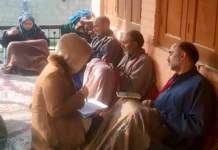
In the room, five to six middle-aged men sit by a wall, engrossed deeply in their work. A customer, also middle-aged, stands in front of them. The room has two doors. One leads to the staircase. The other opens into a smaller room, where a middle-aged man is busy at his own work.
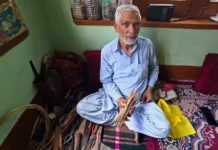
He is surrounded by a pile of carved wooden boxes and tins of varnish polish. He is shy and does not look into the eye. “Manzoor Ahmad,” he said in a very low tone when asked his name. He is a resident of the Nowhatta area of Srinagar.
Manzoor and the other six men have been involved with the process of woodcarving for several decades, and the old rooms have acted as their kaarkhana. Woodcarving is one of the many crafts that Kashmir is known for, and people, especially from the old city areas, have long been involved with the work.
The Craft
The room that acts as Manzoor’s workstation is clean, and carved wooden boxes, tables and bed crowns can be found. Behind him are open shelves where old photographs, an old calendar, and some old boxes and bottles of polish rest as pieces of souvenirs. The floor of the room bears testimony to the old age of the kaarkhana. “The kaarkhana is very old,” he said. “It is more than 80 years old.”
Manzoor said that he has been involved with the craft for the past forty years. “I have worked at many other places before,” he said, his gaze lowered. The texture of his hands and the roughness of his skin give an idea of his experience.
He has been involved with the polishing of wooden boxes for a long time now. “I am more well-versed in polishing than other things,” he said. At present, Manzoor is working on polishing boxes that are to be exported to a Middle East country.
Manzoor said that the current generation is not interested in this craft. “My child will not be interested in doing this work. And when there is no successor, the craft dies, right?” he questioned. He said the craft is not as flourishing as it was in the past. Working more than nine hours a day, he earns almost Rs 800.
A Second Trade
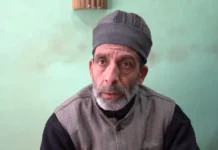
Another man, who sat in the bigger room, was involved with the craft of shawl baafi, or pashmina kaem, initially, before later shifting to woodcarving. A resident of Fateh Kadal, dressed in grey and black, he said that most people from his locality were involved with handicraft work.
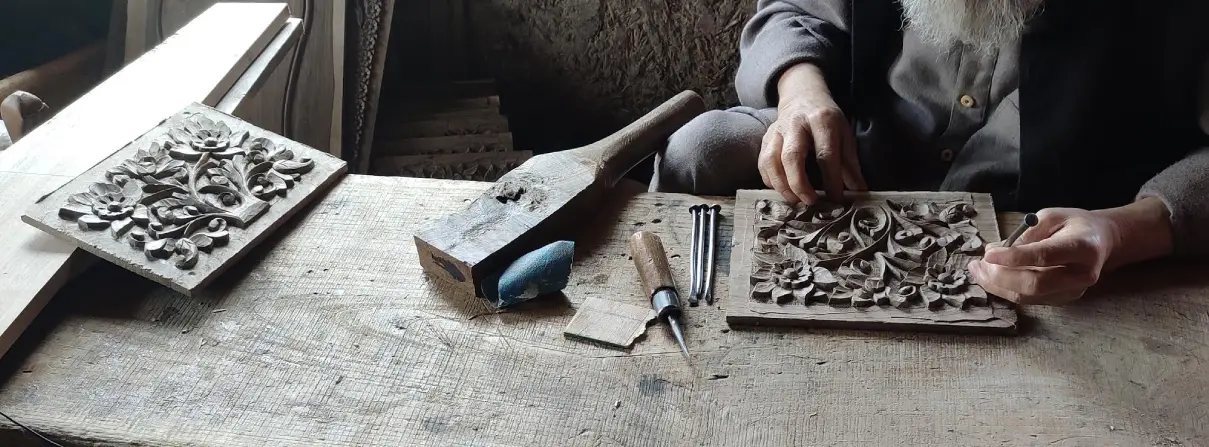
He has been associated with woodcarving for the past 30 to 40 years. “The times, however, are changing. Earlier times were very different. Everything was easy, but now everything is changing,” he said, his eyes glued to his workstation, his old hands operating the chisel through the wood, carving out beautiful patterns on the surface. Different types of nails, which he could effortlessly name, lay in front of him.
Like Manzoor Ahmad, he said that his children too are far away from the craft. “They studied and chose their own paths,” he said. All of the artisans echoed the same thought: that woodcarving demands patience, “which the people of the young generation lack and thus they opt out of learning about the craft,” they said.
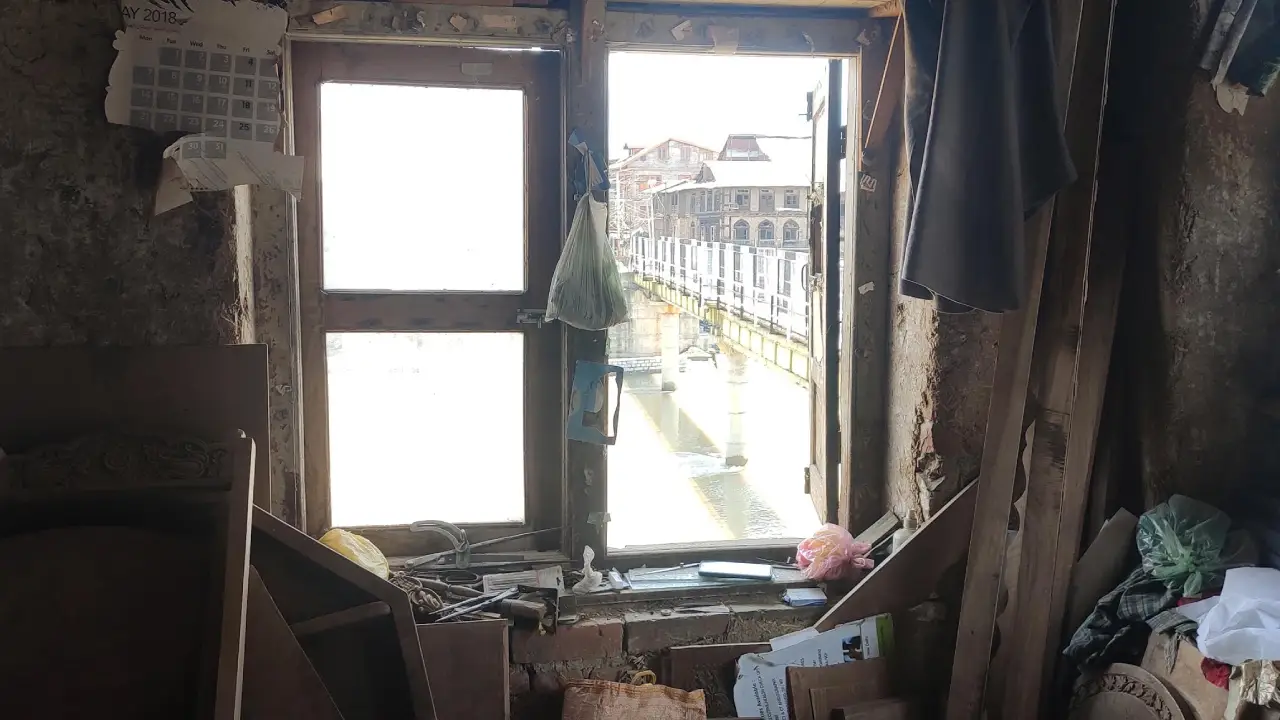
Behind them, on the windowsill that opens towards the road, sit some electronic machinery and an old metallic teapot. The layers of black soot on the teapot mark its long association with the old men.
Heading Downfall
Mohammad Rafiq Bhat, another woodcarver who has been heading the kaarkhana, said the craft of woodcarving is very time-consuming. “We began this craft as we were interested in it, but later we shifted to it full time,” he said. “It almost takes 20 years to learn this skill.”
He has been in the craft for more than 35 years, he said. “This work requires a lot of hard work, effort and honesty. All the people involved with the craft are very khuda dost (God-friendly),” he said.
The old artisans also said that the craft is facing a lot of challenges and is heading towards a downfall. “Now this art will only remain like tabarukh with just a few old artisans, just like some vintage thing, because the younger generations are not interested as there are no profits,” he said.
The old artisans work on carving wooden boxes, beds, tables, wall hangings, chairs and calligraphy. In the main room, full of long planks of wood, besides wooden beds, chairs, tables and boxes at rest, six people sit in a line near the windows. All of them, in their age, seem to mirror the age of the factory itself. Everything present there bears testimony of its long past.
The Kaarkhana
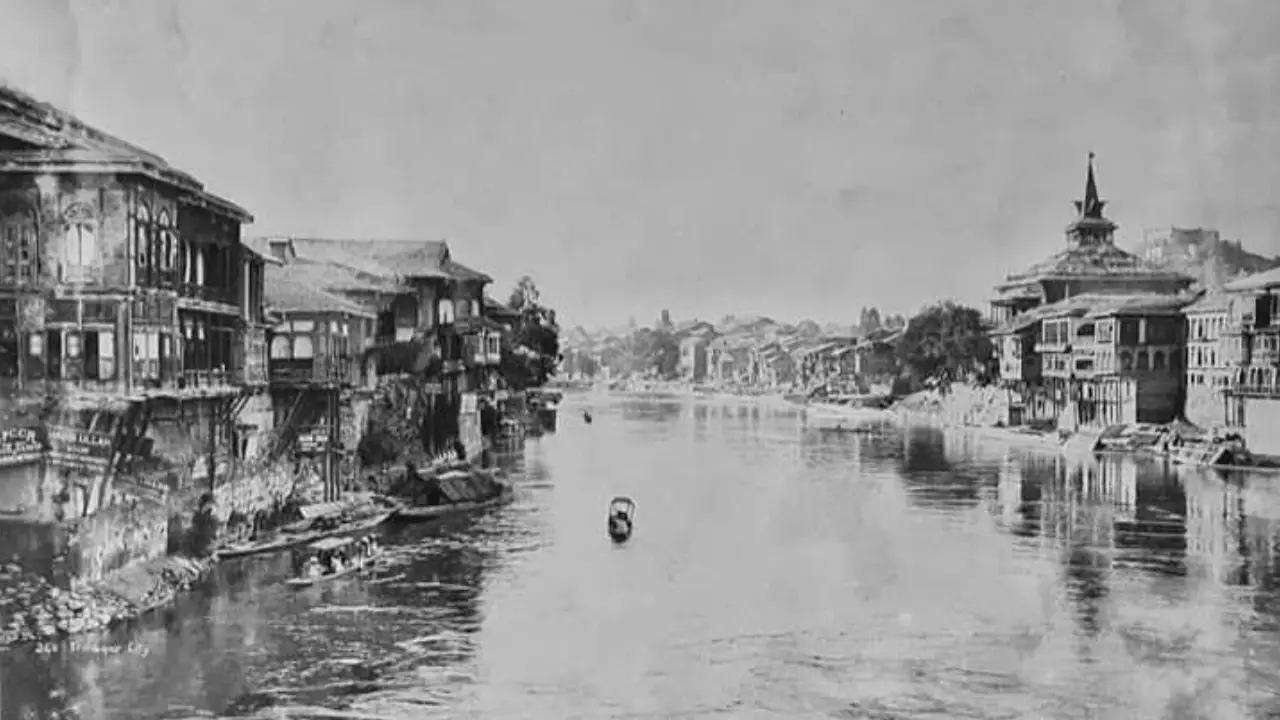
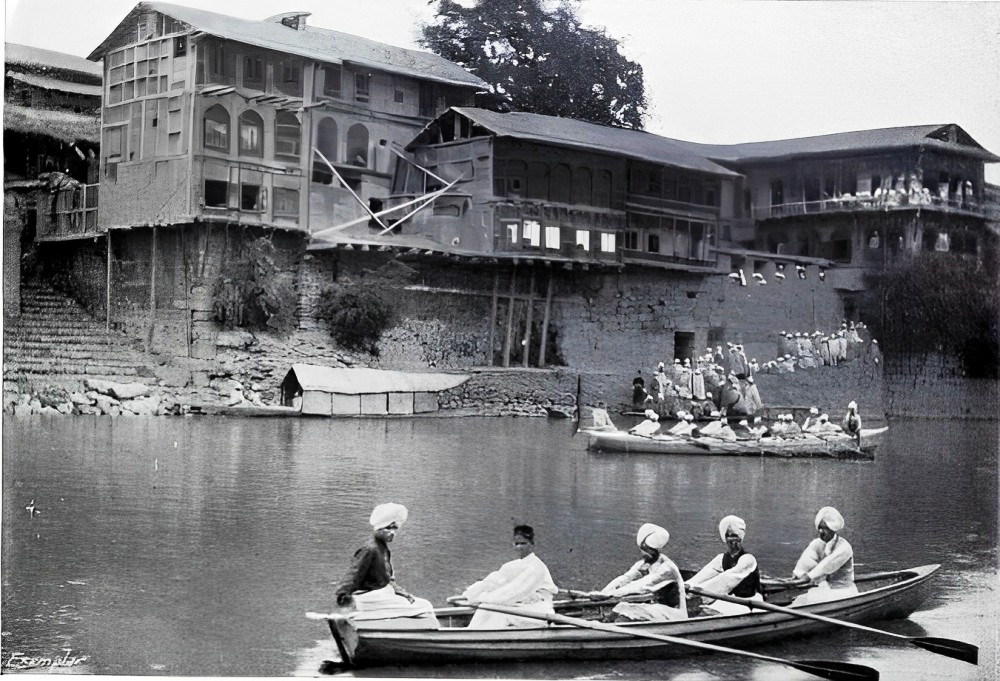
The factory is located inside an old building on the banks of the river Jhelum. The windows of the rooms open to the sight of the river, its banks and the bridge on it. Though the surroundings of the building cannot be called clean, the building has its own strong aesthetics. There is another woodcarving kaarkhana standing face to face with this one. The building has been constructed primarily of wood and mud, and has a lot of windows.
“The building is almost a hundred years old,” said Mohammad Rafiq Mir, who heads the present-day woodcarving kaarkhana, and who has taken on the building on a rental basis from the local mosque committee. “Since it was not being used by anyone, I thought of renting it for my own work.”
It has now been almost 35 years since he, along with seven other people, decided to open the woodcarving station. He said that the kaarkhana was once a showroom owned by a man named Shafi Wanth, who was a very well-off man of his time. “He had a shawl showroom in this building in the past,” he said.
A Market Lost
Mir revealed that in the past, the whole area where the kaarkhana is located was a very famous market of Kashmir arts. “All the buildings present here were showrooms. The market here was dense and thronged by foreign buyers. But with the passage of time, the scenario changed,” he said.
He added that most of the trade work was carried out through riverine transport. “But once that stopped, the showroom lost its customers, and yes, the turmoil era took its own toll too,” he said. It has been more than 35 years since the market in Fateh Kadal started to decline. “You can still find the pictures of the market through your mobile (internet),” he said.
He said that Fateh Kadal was known for its artisans. “Everyone in Fateh Kadal was involved with the ath kaem (handicrafts), that is why we had a flourishing market here,” he added. “The market here was just like the Poloview market.”
Mir has a complaint against the rulers. He said that the administration never tried to revive the historical market. “The administration never tried to talk to the artisans here, or for that matter, they did not even take any steps to help the market from collapsing. Also, the charges for exporting the craft pieces became difficult as well,” he said.
About his kaarkhana, he said, “We are a bunch of old people here who share similar thoughts. Since we cannot gel up with the younger generations, we sit together and talk about older times. We sit on dust and talk. And even if we think of giving up on this work, we cannot, aes maa lagow badal kaensi kaaras (We cannot do any other work, because we are used to this work).”
The kaarkhana, however, is not the only one in the area. Mir said there are other kaarkhanas as well, “even older than ours, and all of them are overlooked by the Masjid committees,” he said.
Before Polo View
Noted author Sameer Hamdani said that Fateh Kadal used to be the hub of the showroom business of Kashmir arts. “There used to be kothis, also known as koatche in Kashmiri, on the riverside where all the artisans used to be. It was during the rule of Maharaja Hari Singh. Artisans who owned these kothis transformed some of their rooms into showrooms and living rooms where foreign tourists and travellers used to visit,” he added. “Then the Fateh Kadal was damaged in a blaze during Maharaja Hari Singh’s rule, and the showrooms were shifted to the Bundh area.”
Sameer said that many famous and well-off people had showrooms in the area. “Before Poloview, the market was in Fateh Kadal. The artisans there mainly had their showrooms in their homes,” he said, adding that the showroom business began there in Fateh Kadal. “It was towards the later part of the rule of Maharaja Ranbir Singh, mainly during the rule of Maharaja Pratap Singh that the businesses there started.”
He said the market was initially located in Maharaj Gunj. “The showroom business could not flourish there, however,” he said.
The architectural historian of Kashmir, who focuses on the medieval era, named two reasons for the market’s decline. One was the big fire that engulfed Fateh Kadal. The other, he said, was “the shift and relocation of the market towards Bundh. However, the market there was also damaged in a fire, and during the Bakshi rule the shops were again relocated.”
About the old buildings that have now been converted into kaarkhanas, he said, “Most of the houses and buildings in Srinagar were either reconstructed primarily because of the frequent fires, or the second reason being the renovation works were carried out too on the dilapidated houses and buildings.”
About the transformation of the showroom buildings into woodcarving kaarkhanas, he said that all of the handicraft works are interlinked. “The artisans back then used to have multiple crafts related to the Kashmir arts, so it, in a way, used to help them.”