Srinagar’s Simran Irshad turns discarded Dal Lake grass into handmade crafts, creating green livelihoods for women while seeking government support to scale production, Mudasir Majeed Pir reports
For years, the grass and vegetation cleared from Dal Lake have been treated as waste. Simran Irshad, a 35-year-old woman from Nowshera, Srinagar, saw a possibility in what others discarded.
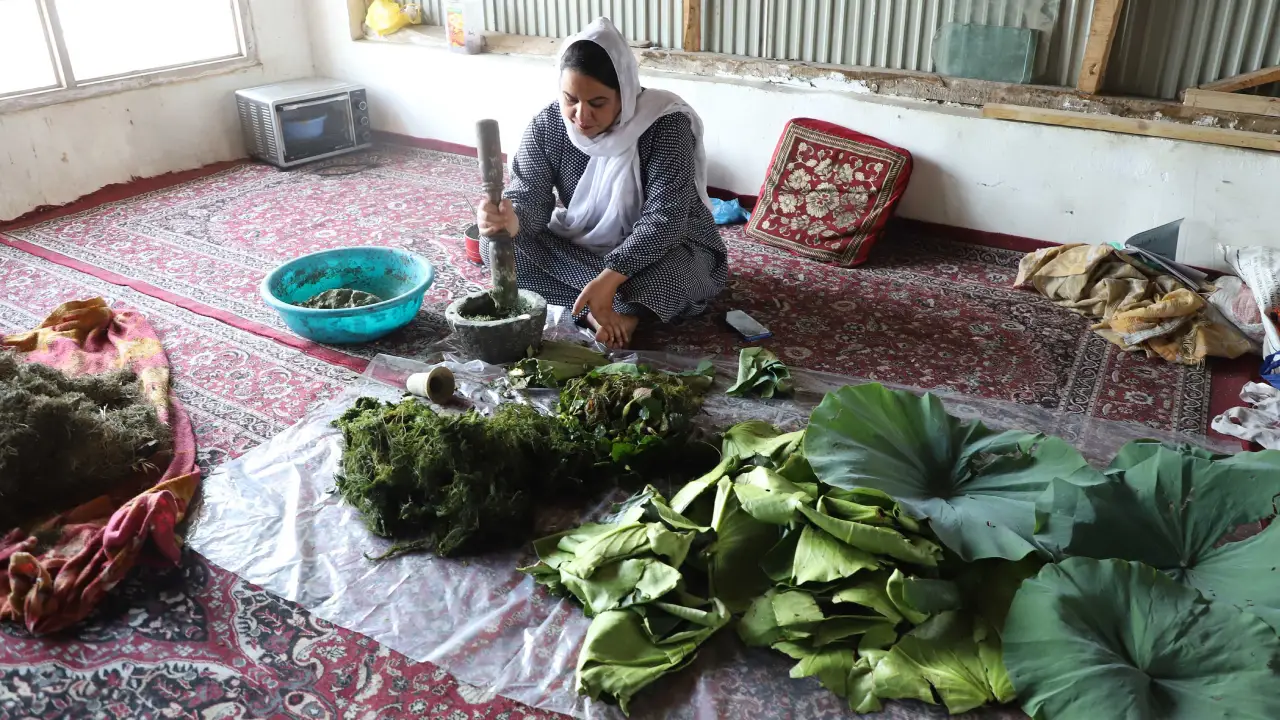
What began as an experiment with paper pulp took her towards a very different material: the grass that grows around Kashmir’s parks and water bodies, including vegetation removed during the harvesting of Nadru and Singhara from Dal Lake. She began processing the ‘waste’ into pulp and using it to create handmade objects, much like the traditional process of papier-mâché.
Simran dropped out of school in 10th standard and started getting close to the local male-dominated artisan community. “I was repeatedly told that, as a woman, I belonged at home. After persistent efforts, I found my mentor in Mohammad Yousuf Najar who taught me papier-mâché,” recalled Simran. Soon after, she settled in life with Irshad Ahmad, a tailor, who is a huge support to her. They have a son, now 5.
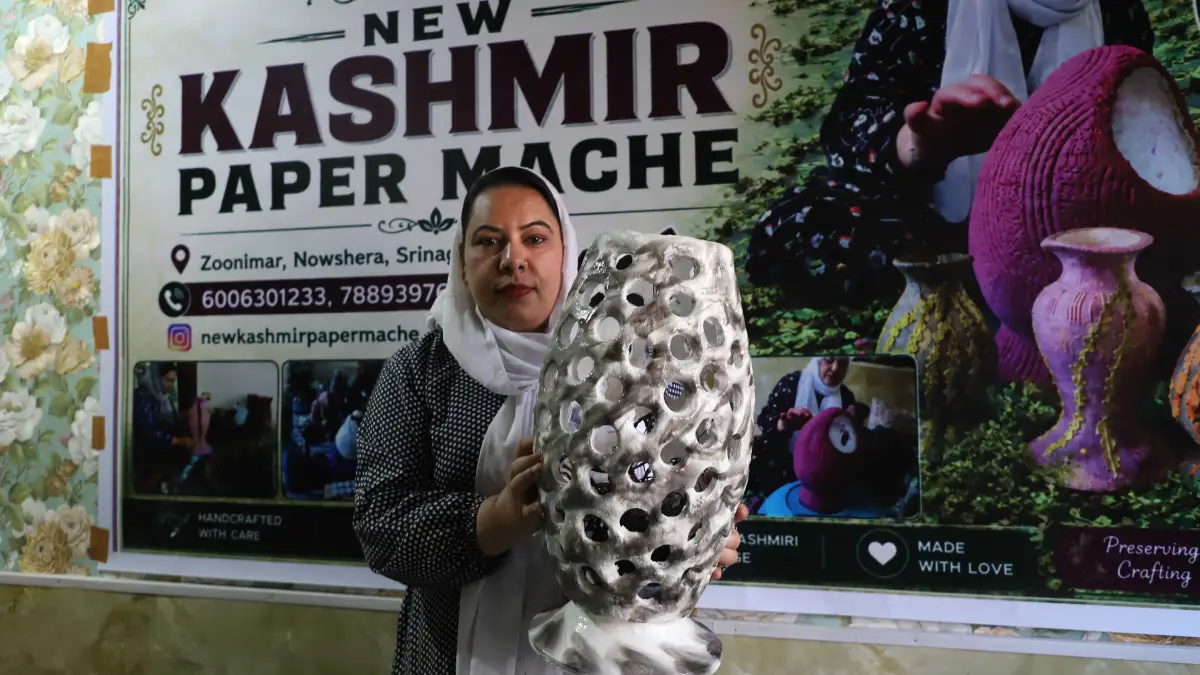
Simran calls this new form of eco-friendly art Grass mâché. The idea was born from a simple question: if paper comes from trees, what happens when those trees become scarce in future?
“I was initially working with paper pulp,” Simran said. Paper comes from trees, and if the craft depended entirely on it, she wondered what would happen in the long run. Classrooms and official files are increasingly getting paperless, and not many people read newspapers now. “That kept going around in my mind that my craft would eventually end,” she recalls.
Slow Process
It was not an overnight transformation. Developing the process took her nearly two years. The discarded vegetation had to be processed and converted into pulp before it could be moulded into objects. Slowly, through trial and error, she found a way to make the material work.
The result is a form of craft that connects two ideas: Kashmir’s longstanding handmade traditions and the growing need to find new uses for ecological waste.
Simran sees the material itself as an opportunity. What is considered worthless can become useful, and what is thrown away can become a source of livelihood. Her work has also changed the way she looks at Dal Lake.
Clean Lake
“The residents here depend on tourism,” she said, pointing to the connection between Kashmir’s tourism economy and the condition of its iconic water bodies. For her, keeping Dal clean is not simply an environmental concern. It is also an economic one.
“If the Dal is clean, tourism will flourish,” she believes. Tourism forms the backbone of Srinagar’s economy. “If Dal Lake, the face of Kashmir’s water beauty, looks ugly, what will we have to show tourists? Their reactions have made me think about how the waste could be turned into something productive rather than simply discarded.”
Growing Pains
Simran wants women, including young people looking for work, to learn the craft and earn from it, in a place where unemployment remains a concern. She is willing to teach others but needs facilitation.
Space is a resource, but Simran’s biggest problem. A machine is another requirement, limiting how much she can produce and how many people she can involve. Getting the product into the market is a further challenge.
Simran said her products have not yet fully entered the market, even though she believes there is significant demand. She points to interest from foreign visitors, who often appreciate handmade products made from unusual and sustainable materials. That demand gives her confidence in the idea.
Wider Vision
Simran hopes to build a women-led craft platform that turns discarded local materials into a small industry, but needs government support and funding to make it viable. She is asking the officials to see her products and understand the work behind them. Only government support can help her take the initiative forward.
“My business holds huge potential for employment generation. I have always wanted to be at the front, particularly when it has been about women’s improvement. But due to the lack of financial resources, my dream project runs the risk of failing,” she says.
Her argument is straightforward: if a small experiment can turn waste into a product, the idea could be mass-produced to create employment while addressing an environmental problem.
Simran spent her first years establishing her identity. It took about two years before she began to see success. What began as an idea gradually became something she could call her own.
Now, she wants others to have the same opportunity without spending years finding their way alone. “I don’t want their two years to go the way my two years went,” she says.
Dal Lake supplies the raw material. Kashmir’s craft tradition supplies the inspiration. Simran’s experimentation provides the bridge between the two. And somewhere between the lake’s discarded grass and the finished handmade object lies her larger proposition: waste does not necessarily have to be the end of a material’s story. It can be the beginning of another one.