In Kashmir, the rapid surge of digital banking has brought both opportunity and danger. As Babra Wani shows, stories range from losing a few thousand rupees to entire life savings disappearing in a single click, capturing how the Valley stands torn between the promise of cashless convenience and the rising threat of cybercrime

On September 3, a well-read lady in an uptown locality was busy scrolling the web on her phone when she got a message about a substantial amount being debited from her account using the UPI application. Busy hunting for news about the state and status of Jhelum, she skipped reading it. The next day, she read it, and by then, Rs 40,000 had been deducted.
Remotely, somebody had started working on her phone quite early. One day, she got a message that one rupee was deducted and re-credited. The next day, Rs 4000 was deducted and re-credited. Then Rs 5000 was taken out and re-deposited – all alone. The lady, not tech savvy, could understand that her phone as well as her bank account had been compromised. Then finally they took away all entire money that she had in her account.
“I thank God that if the account was compromised last week, I would have lost something that would impact the future of my child,” she said, on the condition of anonymity. “The bank and the cyber cell of the Jammu and Kashmir Police are trying their level best to locate the money and recover it, if possible.”
Briefing cops about the modus operandi, she said she has never used internet banking. She denied ever applying for UPI as the mode of transaction. “They did not even ask for an OTP. I do not know where my money has gone,” she said, crying over the loss. She has formally registered a police case, and the bank has also taken up the issue. The initial information that the bank has offered is that fraudsters initially took the money in a nationalised bank account and later withdrew using an ATM in Tripura. At the face of police told her that her cell phone seemingly is compromised, which eventually led her to freeze her account, her debit and credit cards.
Not A Sole Victim
As the lady went to submit a draft complaint online, one of her relatives said the real extent of the crisis was revealed. There are various Photostat shops near the cyber police station, which are specialists in managing the online complaints of online fraud victims. They know the extent of the crisis as well.

“Normally, we draft and submit around 20 complaints a day,” one of the three major “specialists” said. “There are interesting cases, and the highest value one person has lost is above Rs 10 lakh.”
The most important things that help people recover whole or part of their losses the quick action. “The world is so fast,” the middle-aged man, busy watching tapori videos online, said. “The possibility of recovering the lost money becomes very difficult if the victims get late.”
He has interesting stories to share. A teenager was playing a particular online game and lost Rs 8 lakh. She stayed silent till her mother knew things and rushed to the police station. “Police recovered Rs 5 lakh within 24 hours,” he said. “She resumed playing and lost Rs 3 lakh in the next 24 hours.”
As the lady was getting her complaint filed, there was a businessman dictating entries of the fraud from his account. “I ignored the messages, and when they started getting more frequent, I went to the bank and found I had been looted,” he said, refusing to offer any details about the quantum of money that fraudsters had debited from his account.
Financial Inclusion
Jammu and Kashmir is one of the places where financial inclusion is massive. Almost everybody has to have a bank account. Bank account is linked to the social welfare schemes, salaries, pensions and everything. Every account has Aadhar and other personal details, including cell phones and e-mails attached. Once a fraudster gets even one part of the personal details, the efforts at loot start.
Banks told the government in February 2025 and later in July 2025 that more than 99 per cent of the transactions taking place in the banking sector in Jammu and Kashmir are digital. Plenty of transaction apps have added yet another layer to the banking setup. Apart from the UPI platform, there are apps like GPay, MPay, PhonePe, and Paytm.
Jammu and Kashmir Bank, like other banks, often sends advisories warning customers not to click on suspicious links. The JK Bank holds two-thirds share in the banking sector of Jammu and Kashmir and is considered more responsible than others.

By the end of 2024, the banks told the government early this year, the banking sector recorded 138.9 crore transactions in nine months of the financial year. Of this 131.13 crore, which is 94 per cent, were digital transactions. Interestingly, the UPI was used in 91.38 crore transactions, which is 70 per cent of the total digital transactions that took place in Jammu and Kashmir. This is just the number of transactions, not the quantum of money that was involved.
Story Telling Numbers
In the Lok Sabha, the Ministry of Finance revealed the scale of the crisis. In 2019–20, Jammu and Kashmir recorded 109 fraud cases worth Rs 0.32 crore. The following year, the number dropped to 105, though the value rose to Rs 0.49 crore. In 2021–22, 76 cases were reported involving Rs 0.37 crore.
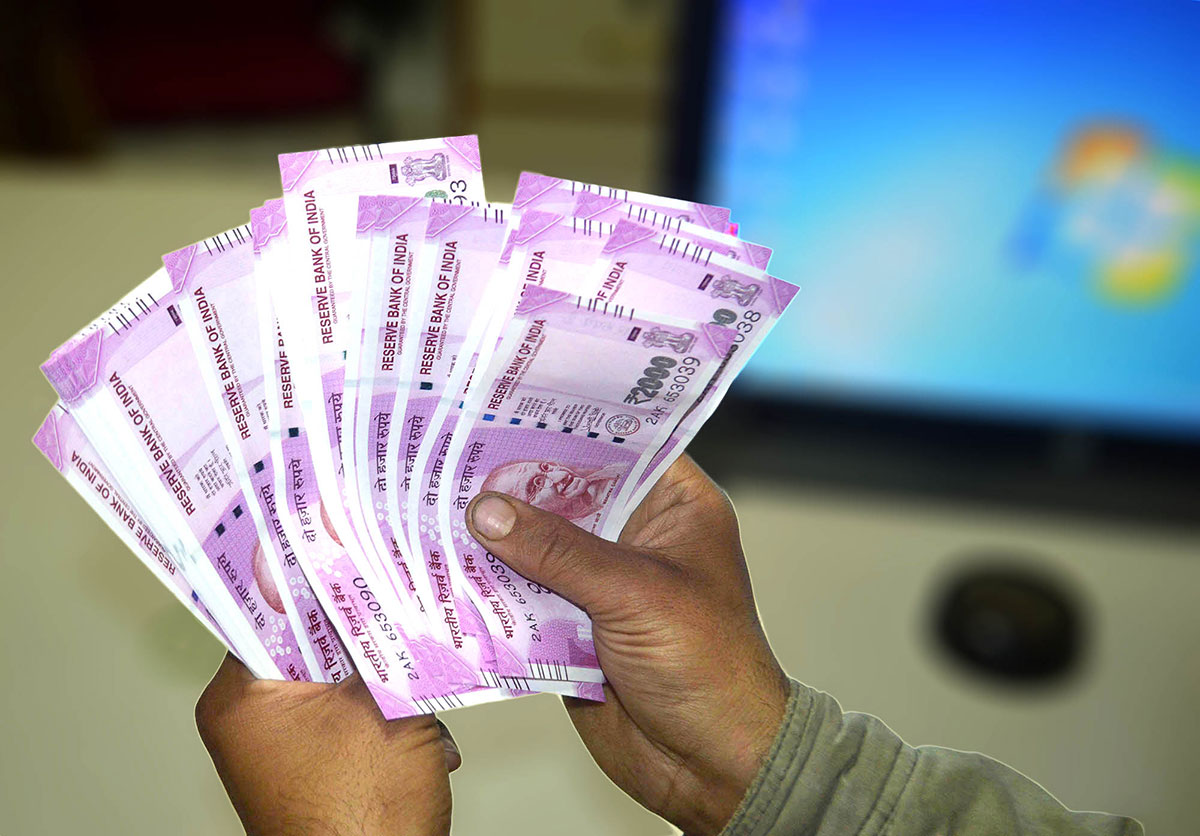
The situation is grim across the country. Digital frauds have risen from Rs 2,306 crore in 2022 to Rs 22,842 crore in 2024, and are projected to cross Rs 1.2 lakh crore in 2025, according to DataLEADS and the Indian Cybercrime Coordination Centre. Nearly 20 lakh cybercrime complaints were filed in 2024, ten times more than in 2019, highlighting the growing sophistication of online fraudsters. The boom in UPI-based digital payments, particularly post-pandemic, has expanded access but also fuelled scams across banking, insurance, and investment sectors.
Criminals, the report said, exploit platforms like WhatsApp, Telegram, and Instagram for phishing, fake listings, and payment scams, often leveraging AI and deep fakes. Private banks saw most incidents, but public sector customers suffered the heaviest losses.
Banks Warn
Experts warn that India’s vast digital ecosystem, while transformative, remains dangerously exposed to organised fraud networks, underscoring the urgent need for stronger regulation, accountability from social media firms, and greater public awareness. Banks are doing a bit of their own.
“Dear Customer, never download any app or click any link on the advice of strangers. Fraudsters can access your personal data with such apps or links. J&K Bank.” This is the routine message that JK Bank sends to its customers.
This advisory had reached Saba from Anantnag two months ago. Moments later, she received another message: Rs 500 had been withdrawn from her account. Checking her MPay app showed no record of the transaction.
Confused and angry, she filed a grievance complaint. The next day, she received a call, supposedly from the bank. The caller explained the transaction and then urged her to withdraw her complaint. When she refused, her relatives were pressured to convince her. “The pressure was overwhelming. I had to delete my complaint from the app before they stopped troubling me,” Saba said.
The Daily Battle
A senior cyber police officer confirmed that the department receives fraud complaints daily. “Sometimes the number of such calls is very high. We lodge FIRs and help people. Cyber fraud is common, which is why we advise vigilance. People must not click on unknown links.”
According to the Citizen Financial Cyber Fraud Reporting and Management System, over 1,000 financial fraud cases amounting to more than Rs 780 lakh were registered in Jammu and Kashmir in 2024. Nationally, UPI and internet banking-related frauds now account for nearly half of all cybercrimes.
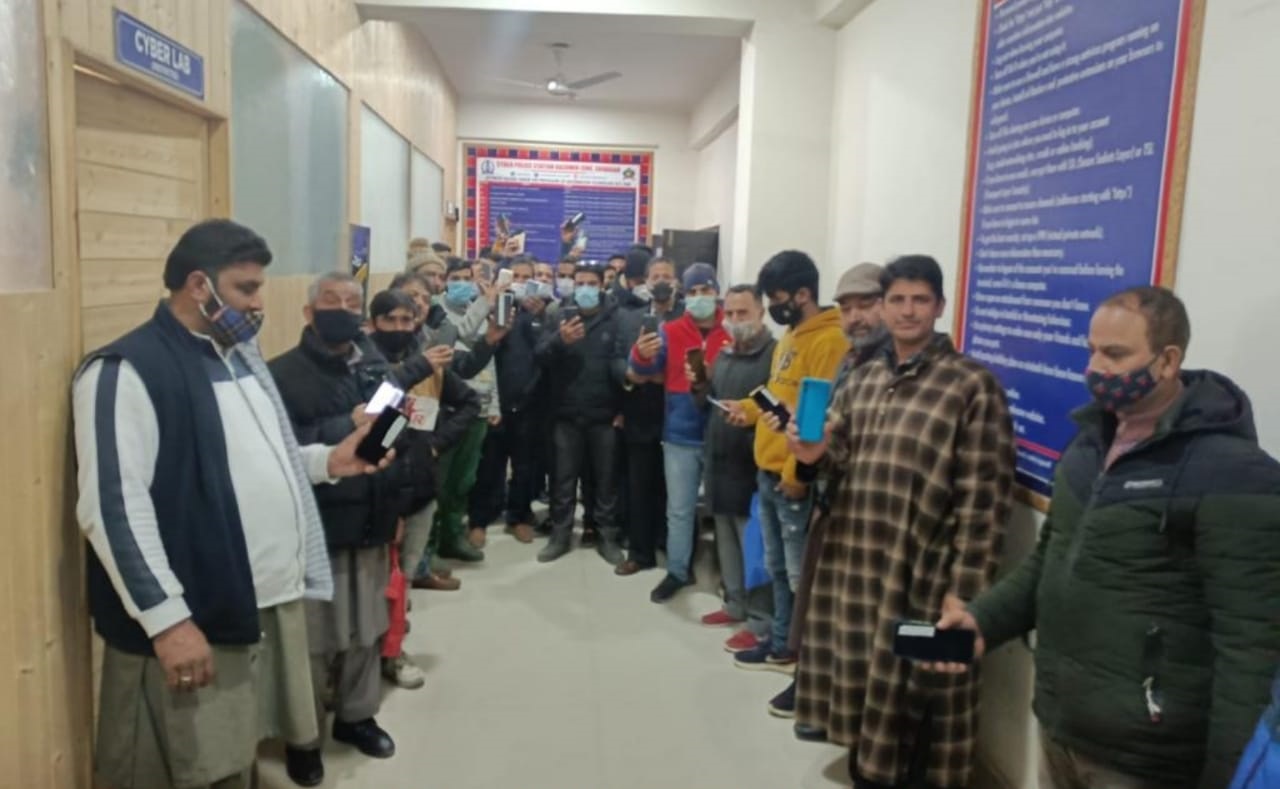
Some people have managed to stay a step ahead. Nadeem from Srinagar received a message claiming money had been credited to his account. He chose not to open it. “Truecaller helped me identify it as spam. Had I clicked, I would have lost my money,” he said.
Officials confirm that different types of fraud, including those linked to UPI, credit cards, QR codes, and digital banking, continue to surface in Jammu and Kashmir. Data from the Ministry of Finance shows the rise has been steady. In five years, more than 830 cases were reported, with losses crossing Rs 1 crore.
Rising Tide of Cyber Frauds
Official records show that in 2020-21, Jammu and Kashmir reported 105 fraud cases with losses of Rs 0.36 crore and no recovery. The following year, 2021-22, saw a decline to 76 cases, losses of Rs 0.14 crore, and no recovery. In 2022-23, cases fell further to 66, but losses rose to Rs 0.22 crore, with Rs 0.11 crore recovered.
The downward trend reversed in 2023-24, when 370 cases were registered. Though losses were lower at Rs 0.15 crore, no recovery was made. In 2024-25, up to the reporting date, 215 frauds had already been recorded, with Rs 0.21 crore lost and only Rs 0.01 crore recovered.
Between 2020 and 2025, the region reported 832 cyber and digital financial frauds. Total losses reached Rs 1.08 crore, while recovery stood at Rs 0.12 crore, barely above 10 per cent.
Bank Response and Cyber Gaps
“We have a Transaction Monitoring Cell that works 24×7 and monitors transactions across the spectrum,” a senior officer at JK Bank explained. “Any reported fraud automatically triggers a request for FIR to the cyber police.” He added that complaints about transactional fraud are addressed without delay.
A cybersecurity expert noted that criminals exploit the public’s lack of digital literacy, taking advantage of trust and gullibility. He urged people to carry out background checks before engaging online. “We need to learn how to use social media platforms responsibly and understand how digital media works,” he said.“If someone asks you to fill out a form, make a payment, or join a Telegram channel to receive money, it should raise red flags.”
Kashmiri cyber expert Irfan Attari stressed that digital literacy is now vital for both empowerment and protection. He said while digital platforms provide access to knowledge, skills, and economic opportunities, growing dependence on technology has also fuelled financial fraud. Cybercriminals exploit the digitally unskilled through phishing, identity theft, and scams, making awareness as important as access. “A digitally literate society is not only empowered but also financially resilient and secure,” he noted. A Cyber Police Department source said around 20 financial fraud complaints are filed daily in Kashmir, with losses ranging from Rs 50,000 to Rs 10 lakh.
Surge in Digital Transactions
Despite rising fraud, digital banking in Jammu and Kashmir has grown sharply. In June 2025, JK Bank reported more than nine crore transactions worth Rs 12,149.45 crore across its platforms between June 1 and June 6. The bank’s consolidated data reflected a strong shift towards cashless payments, with customers preferring mobile apps, UPI, eBanking, and other digital tools.
UPI emerged as the most used channel, recording 5.76 crore transactions, including 3.11 crore financial and 2.68 crore non-financial, amounting to Rs 4,393.08 crore.
According to a recent document, Jammu and Kashmir achieved 99.80 per cent digital coverage of eligible savings and business accounts, with 1.28 crore accounts onboarded across all 20 districts. As of January 31, 2025, only 25,472 accounts were yet to be digitally enabled.
Banks Lead in Coverage
The document recorded that Jammu and Kashmir Bank and the State Bank of India had achieved full digital coverage. Punjab National Bank stood at 99.49 per cent for savings and 100 per cent for business accounts. HDFC Bank had 99.93 per cent in savings and 99.78 per cent in business accounts, while ICICI Bank had 100 per cent in savings and 99.70 per cent in business accounts. Canara Bank reported 98.25 per cent in savings and 99.84 per cent in business accounts.

Jammu and Kashmir Bank showed the strongest progress. In the financial year 2024-25 (up to December 2024), it processed 138.90 crore transactions, 99.80 per cent of which were digital, with UPI alone accounting for 70 per cent. By comparison, in 2022-23, the bank processed 82.83 crore transactions, 86 per cent digital and 47 per cent via UPI. In 2023-24, it handled 126.15 crore transactions, 90 per cent digital and 55 per cent through UPI. The upward trend continued in 2024-25 with 94 per cent digital and 70 per cent via UPI.
Scams and Cyber Threats
Cybersecurity expert Sheikh Asif cautioned that fraudsters have advanced beyond OTP-based thefts, using sophisticated tactics to steal money. Many victims were tricked into installing malicious apps from unverified sources or clicking fake reward links. Others were duped by fraudsters posing as officials to extract Aadhaar details and personal documents. Small business owners were particularly vulnerable, falling prey to fraudulent loan schemes where their KYC papers were later misused. He stressed that people must never share OTPs, Aadhaar, or KYC details, and should avoid installing unknown applications or giving remote access to their phones.
Echoing these concerns, cyber expert Irfan Attari said scams today extend far beyond OTP thefts. Criminals exploit call forwarding, SMS interception, SIM swapping, and fake emails to breach internet banking. Malicious apps harvest sensitive data, while phishing links and fake customer service calls trick victims into revealing partial information that is later misused. He said the rise of such scams underscored the urgent need for digital literacy, cyber hygiene, and tighter monitoring of banking systems.
This is particularly relevant in Jammu and Kashmir, where, by March 2024, all 20 districts were digitally enabled, covering 99.51 per cent of savings and business accounts. In 2023-24 alone, banks in the region recorded 36.01 crore digital transactions worth Rs 3,74,957.17 crore, reflecting both the opportunities and risks of the digital boom.
Rising Credit Transfers
In credit transfers, Real-Time Gross Settlement (RTGS) values increased from Rs 1,31,555.93 crore to Rs 1,38,510.63 crore. Aadhaar Payments Bridge System (APBS) usage grew strongly, with transactions rising from 8.8 million in 2022-23 to 13.6 million in 2023-24, and value climbing from Rs 1,316.89 crore to Rs 2,583.83 crore.
Immediate Payment Service (IMPS) also surged, from 22.8 million transactions worth Rs 17,677.30 crore to 32.8 million valued at Rs 23,553.00 crore. In contrast, National Automated Clearing House (NACH) Credit transactions declined, with volume dropping from 12.2 million to 7.8 million and value falling from Rs 22,350.15 crore to Rs 16,805.23 crore.
National Electronic Funds Transfer (NEFT) transactions grew steadily, with volume increasing from 26.2 million to 34.8 million and value rising from Rs 1,18,457.45 crore to Rs 1,40,006 crore. UPI, however, outpaced all others, with transactions jumping from 123.2 million to 211.3 million and value climbing from Rs 37,511.40 crore to Rs 40,289.82 crore, consolidating its position as the most popular mode of payment in the region.