Prehistoric finds from Nubra, Zanskar and the Upper Indus suggest Ladakh’s high mountains were corridors of movement, occupation and cultural exchange, not barriers. A new archaeological volume reopens the region’s deep past.
For a long time, Ladakh was imagined through geography alone. It was a cold desert of difficult passes, sparse vegetation and extreme climate. Such a place seemed inhospitable to sustained human life. Its remoteness was treated as a historical condition in itself. The region appeared peripheral to the larger story of settlement and cultural change in the subcontinent.
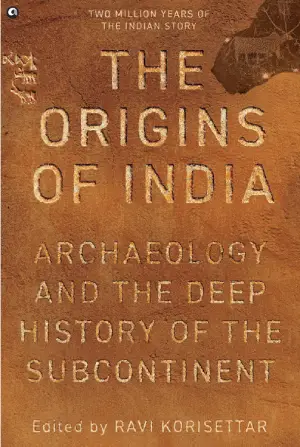
A new volume of essays challenges that view. The Origins of India: Archaeology and the Deep History of the Subcontinent, edited by the eminent archaeologist Ravi Korisettar, gathers the work of some of the finest archaeologists to examine diverse finds across the subcontinent. Korisettar is well placed to steer such a project. An Adjunct Professor at the National Institute of Advanced Studies, Bengaluru, he is Honorary Director of the Robert Bruce Foote Sanganakallu Archaeological Museum in Ballari.
Korisettar’s volume is an ambitious effort in reimagining the subcontinent’s past through archaeology. It spans nearly two million years, from early human dispersals to the Indus Valley Civilisation and beyond. Its central claim is that modern scientific dating and genetic research have revolutionised Indian prehistory. Old assumptions no longer hold.
The book has four sections. Section I is an introduction. Section II covers current issues and debates. Section III turns to the Indus. Section IV traces transitions to early history.
Fresh discoveries from early Iron Age sites in southern India challenge long-held timelines. They suggest that technological advances came much earlier than once believed. The prose is accessible and thoughtful. The essays connect physical artefacts with wider questions of human culture and resilience.
Among them is a chapter on Ladakh by S B Ota. It argues that the mountains were not barriers so much as corridors of movement, occupation and interaction.
Ladakh Reconsidered
Ota’s chapter, Archaeology of Ladakh: Retrospect and Prospect, places Ladakh within the wider archaeological landscape of the Trans Himalayan region. Its prehistoric past, Ota argues, remains poorly understood largely because of assumptions about environmental constraints.
The evidence points elsewhere. Surveys, excavations, lithic assemblages, hearths, animal remains and rock art suggest a more complex history. Ladakh was neither an isolated enclave nor an incidental passage. It was a landscape that people repeatedly occupied, traversed and adapted to.
The archaeological exploration of Ladakh has a relatively recent history. Ota traces early interest to travellers and scholars, including the Buddhist monk Fa Hien. Systematic engagement with prehistory came much later. Alexander Cunningham documented Buddhist remains in the nineteenth century. His attention fell largely on historical heritage. The German Tibetologist A H Francke arrived around the start of the twentieth century. He added artefacts and observations from across the region. Yet the Stone Age stayed outside the mainstream of inquiry.
Even a basalt flake found by De Terra and T T Paterson during the Yale Cambridge expedition of 1939 changed little. The region stayed neglected for decades. Gradually, geological and archaeological work began to identify prehistoric occupation in valleys and along river terraces. By the 1970s and 1980s, Ladakh had begun to attract more organised attention.
Valley Evidence
The chapter’s most compelling contribution is its account of evidence from the Upper Indus, Nubra and Zanskar valleys. Human presence was not confined to one period or one settlement pattern. It involved repeated camping, seasonal movement and adaptation to local ecology.
In the Upper Indus, geologists of the Geological Survey of India reported early settlements in 1985. They lay near Nurla, Khalsi, Pashkyum and around Kargil. The stone artefacts suggest at least three phases of cultural evolution, from the Lower to the Middle Palaeolithic. The tools included choppers, scrapers, cores and flakes. They were made from local quartzite, granite, sandstone, limestone and chert.
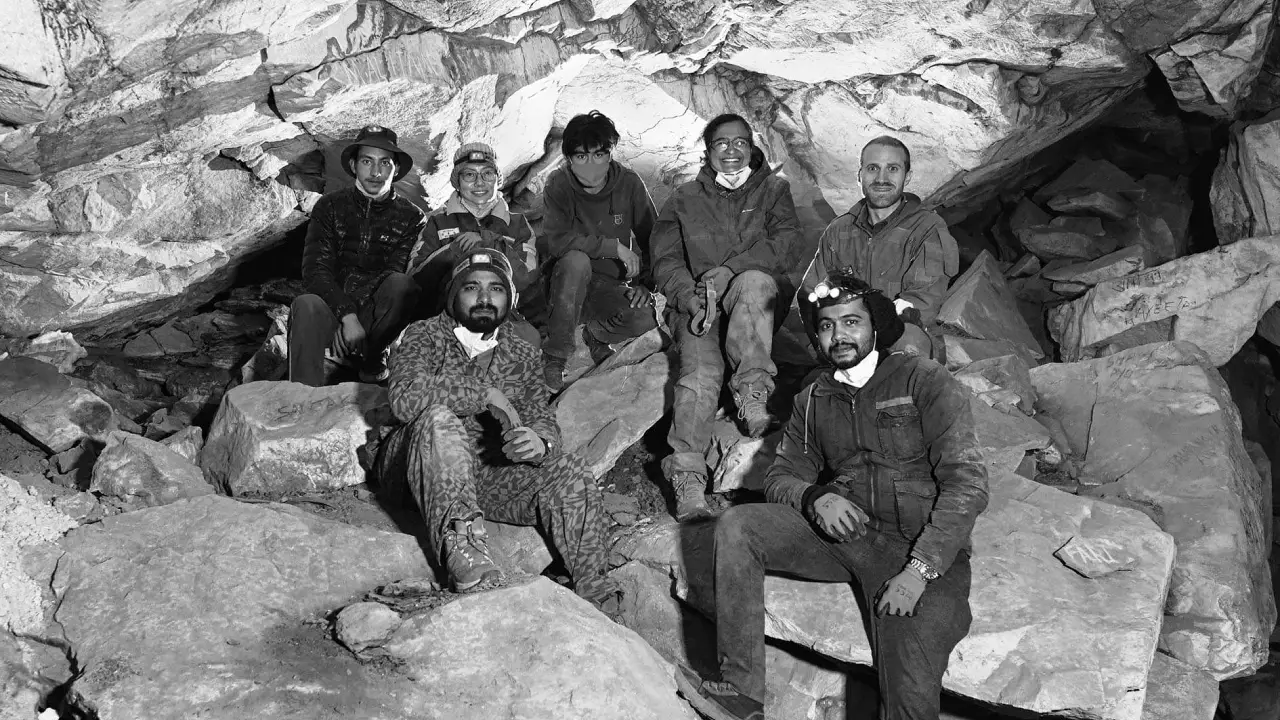
Ota is careful here. Some artefacts came from the surface without stratigraphic association. Their cultural affiliation and chronology are therefore hard to fix. No securely dated layers exist. Certain conclusions remain provisional. Still, the finds have opened a field long neglected.
Nubra Valley
Nubra offers a particularly revealing record. The Nubra and Shyok rivers drain the valley. It has vegetation, water and seasonal pastures. Its links through the Karakoram Pass to Central Asia, Tibet and China make it significant for understanding prehistoric movement.
R S Fonia reported Terminal Pleistocene sites on the terraces around Tirisha Lake. He also found rock shelters at Hundar Dok. The lithic artefacts included unifacial and bifacial choppers, scrapers, hand axes and flakes. Raw materials were chert, quartzite, granite and diorite. An Indo-French team later worked at Slob Phan Tso, near Tirisha. It recovered a substantial assemblage of bifacial tools, choppers, scrapers, flakes and worked boulders.
The geological context matters. Some sites are surface occurrences. Yet the artefacts appear to lie in primary contexts. This lets researchers relate them to glacial landscape processes. Geomorphological mapping and terrestrial cosmogenic nuclide dating suggest the Tirisha artefacts followed glacial retreat. The earliest occupation of Nubra may thus reach back to the Terminal Pleistocene.
More recent work links Nubra to adjoining parts of Tibet and China. At Sasoma Saser La, limited excavations found a prehistoric sequence reaching back to about 8,500 BC. AMS radiocarbon dates support this. The site yielded successive seasonal camps, bone tools, lithic artefacts and faunal remains. The bone tools included scrapers, spatulas and points. The lithics included microblades, cores, flakes and scrapers. They were made of quartzite, quartz, crystal and black chert. Cut and chop marks on animal bones show that meat was an important food. Preliminary study of the remains also points to domesticated animals.
These finds matter beyond antiquity. They begin to show how people lived. Communities combined hunting, pastoral activity, food processing and seasonal movement. Survival depended on knowing pastures, water, animals and climatic rhythms.
Zanskar and Kiari
Zanskar adds another dimension. Near the Darang Drung glacier, a camping site on the road from Kargil to Padum lies at about 4,300 metres. It shows three successive occupations around 6500 BC. Another site, on the road from Padum to Muney, lies at about 3,752 metres. It has two occupational horizons from the Mid Holocene. Even in punishing terrain, seasonal movement and transhumance were possible. Passes, glaciers and rivers were not simply obstacles. People moved through them and made livelihoods there.
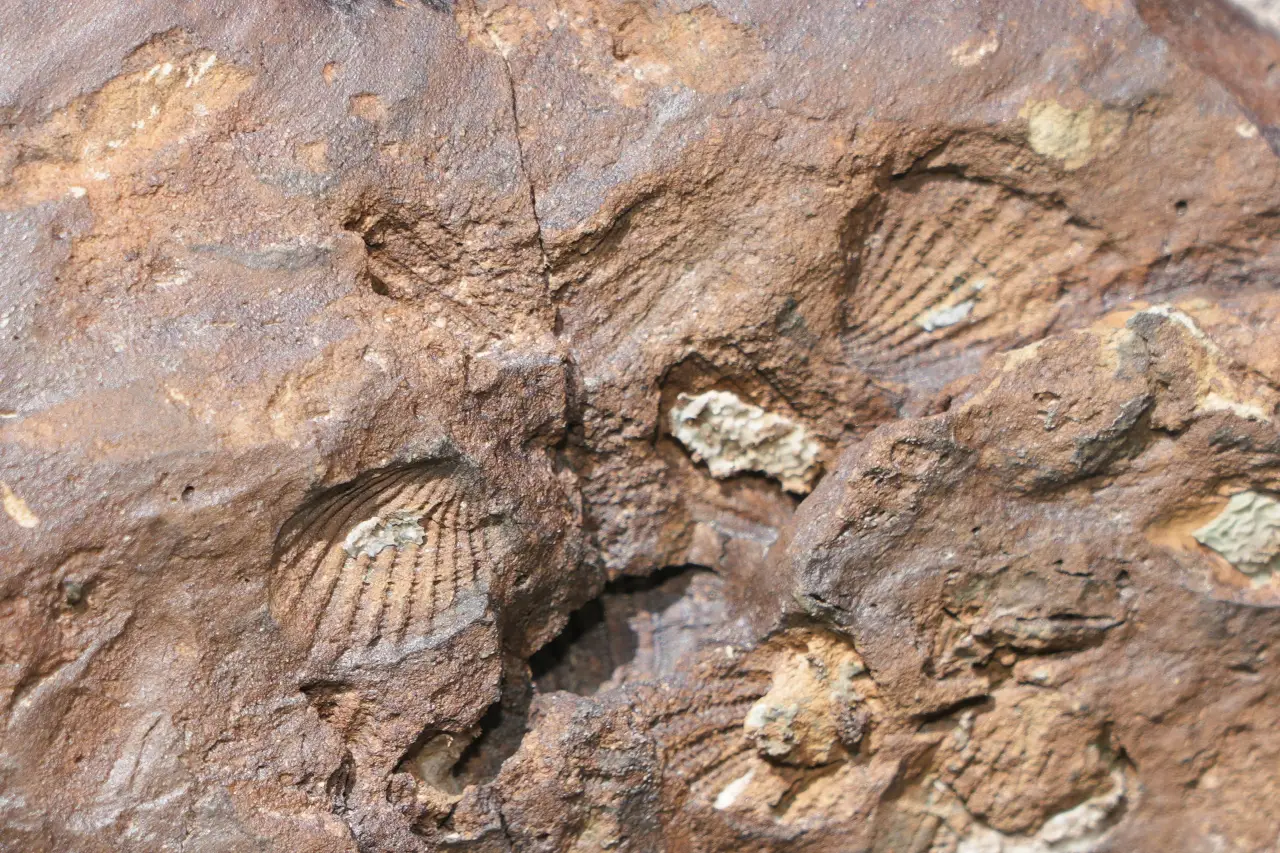
Kiari and Gaik in the Upper Indus enrich the picture. Excavations at Kiari revealed fireplaces, faunal remains, domesticated animals, pottery and burnt clay balls. They also found a saddle quern, a pestle and a burnisher. Successive levels suggest repeated seasonal camping. Summer pastures, fresh water and fuel made the site suitable. The fauna included Bos, Capra and Capra or Ovis. Ota reads the evidence as a pastoral economy supplemented by hunting. Charcoal dates suggest the earliest camping around 1000 BC. The chapter admits uncertainty in the dating and calls for reassessment.
Rock Art
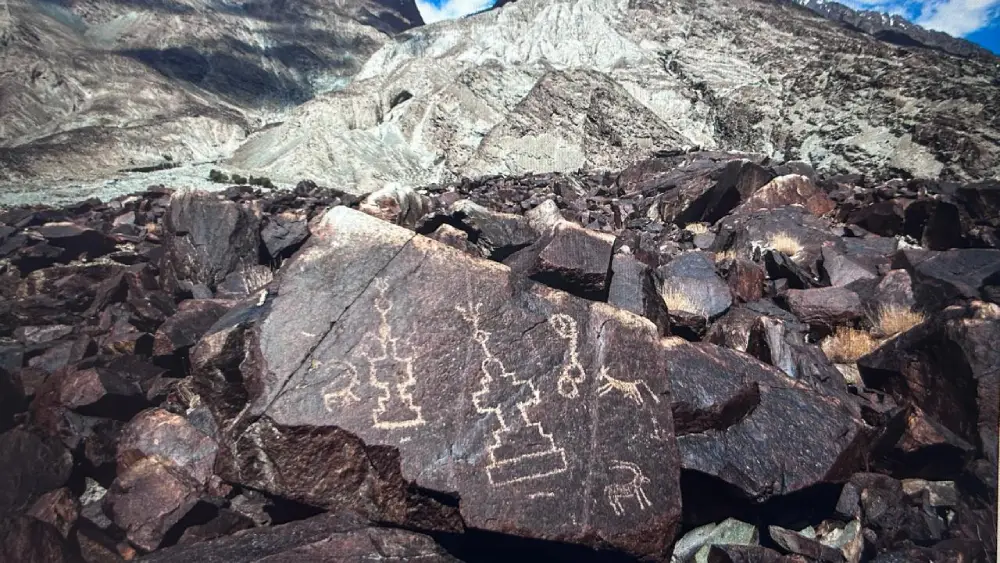
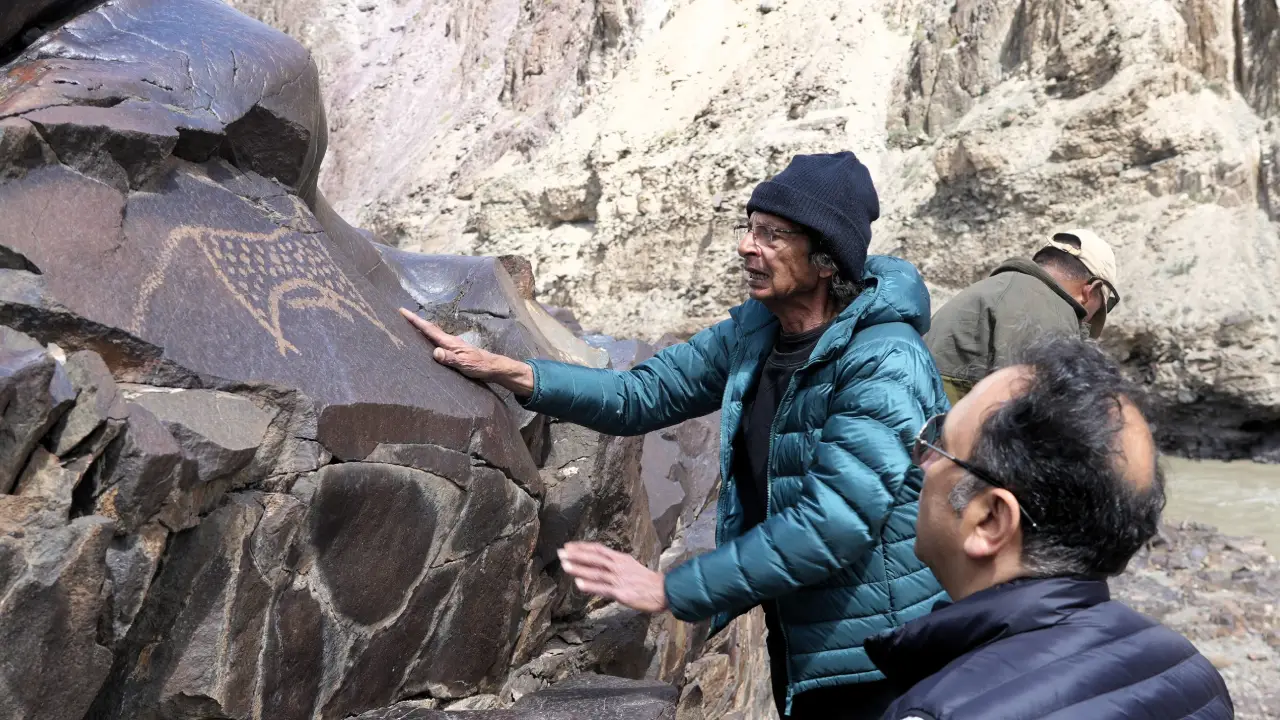
Rock art is another strand. Ladakh has one of the highest densities of petroglyph sites in the subcontinent. Surveys since the 1980s have expanded the record. The Swiss scholar Vernier is credited with recording about 10,000 petroglyphs. L Bruno has since documented a much larger collection across many locations. The richest site is Murgi Tokpo in Nubra, with nearly 3,000 images. Petroglyphs also appear at Sasoma, Diskit and elsewhere. Many sites lie along rivers, streams and ancient routes. Location seems tied to movement and occupation.
The imagery includes human figures, animals, hunting scenes, geometric motifs, crosses, dots and solar symbols. Ota notes parallels with Tibet, Central Asia and southern China. Human figures, masks and horned eagles show stylistic echoes across these regions. He reads this as evidence of contact through the passes.
The chapter does not fix the nature or direction of these contacts. Stylistic likeness alone cannot settle chronology. But it makes a strong case for placing Ladakh in a larger cultural frame. Its remains should not be read as expressions of an isolated local tradition.
What Next?
Ota’s chapter is an argument for revisiting Ladakh’s past. It calls for systematic exploration, excavation, dating and multidisciplinary research. The record remains incomplete. Many discoveries are still provisional. Yet the accumulated evidence already changes how the prehistoric landscape can be understood.
Ladakh emerges as a place where people negotiated altitude, climate, glaciers, rivers and pastures across successive periods. Its record links the subcontinent with the high-altitude environments of Tibet, Central Asia and China. It raises questions about migration, adaptation, cultural exchange and the evolution of pastoral communities.
The chapter’s worth lies not in a definitive history of Ladakh’s earliest inhabitants. Instead, it lies in showing how much remains to be uncovered. The mountains that seemed to separate Ladakh from the world may have joined some of the most important prehistoric landscapes of Asia.