His promise to get the adverse travel advisories downgraded was welcomed by the hospitality sector. But other comments made by US envoy Sergio Gor during his maiden visit to Kashmir added yet another layer to the diplomatic tensions between India and Pakistan
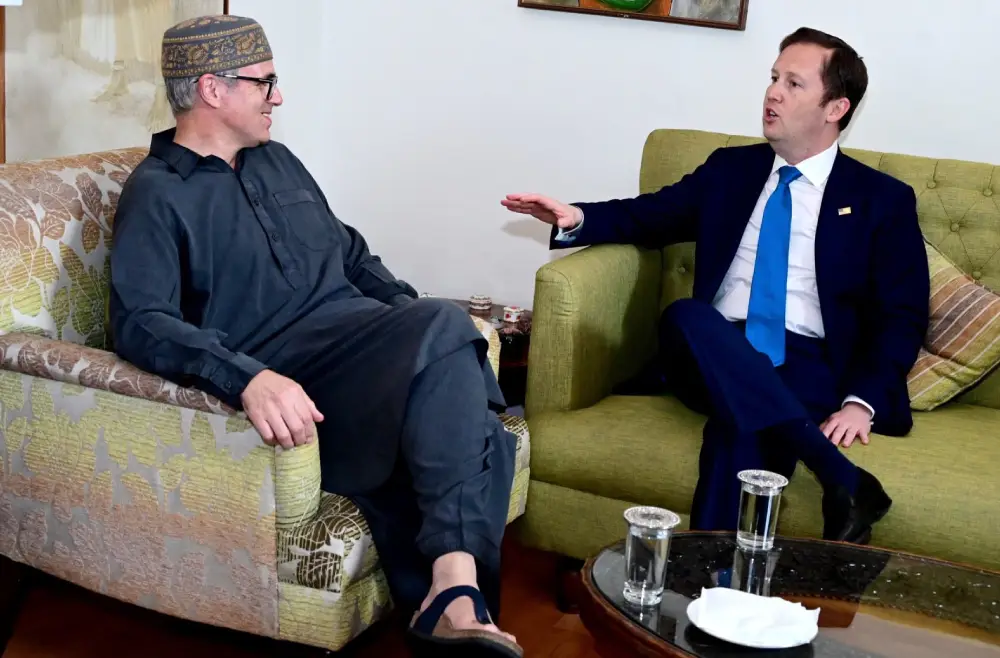
Sergio Gor did not come to Srinagar to make history. He came to see Dal Lake, meet Chief Minister Omar Abdullah, and travel on to Ladakh. That is what he said after meeting Omar. But six words changed that plan. “This is an important part of India,” the US Ambassador told reporters on the evening of August 19, 2026, standing outside Omar’s residence. He spoke about a beautiful place he was thrilled to visit for the first time. He spoke about Kashmir.
Islamabad heard something else entirely.
By August 20, morning, Pakistan’s Foreign Ministry had summoned the US Charge d’Affaires in Islamabad, Natalie Baker, and handed her a strong protest note. The word used was demarche, a term diplomats reach for when they want a disagreement placed formally on record. Pakistan called Gor’s remark factually incorrect and irresponsible.
A Rare Visit
Ambassadorial visits to Kashmir are rare enough that each one becomes a small chapter of diplomatic history. Gor’s trip was the first standalone visit by a serving US Ambassador since Article 370 was read down in August 2019, and Jammu and Kashmir was bifurcated into two federally governed Union Territories.
The last envoy to set foot in Srinagar, Kenneth Juster, arrived in January 2020 as part of a fifteen country delegation brought by New Delhi to explain the changes to foreign governments. Before that, one has to go back further still.
Frank Wisner came in the summer of 1996, ahead of Assembly elections held after years of Governor’s Rule. He met separatist leader Shabir Shah as well as mainstream politicians, a breadth of engagement none of his successors quite matched.
Robert Blackwill followed in December 2002, briefed by Army officers and flown towards the Line of Control, but he met no separatist and condemned militant violence outright.
Timothy Roemer came in March 2011, choosing to meet only the elected Chief Minister, reasoning, later revealed in a leaked cable, that visible American activism on Kashmir could prove counterproductive given New Delhi’s sensitivities.
Each visit reflected the temperature of its moment. Gor’s does too.
A Warm Welcome
Gor met Omar Abdullah on Wednesday afternoon, a meeting both men later called good and cordial. Abdullah said the conversation had a specific focus on what the United States could do for Jammu and Kashmir, while acknowledging what he called certain legacy issues that would need time to resolve. On social media he wrote about widening cooperation in tourism, horticulture, and what he termed the new economy.
Abdullah was careful, though, not to sound like a man airing grievances to a foreign power. In anticipation of the meeting, he had told reporters that it was never his habit to complain about his own country to another nation’s ambassador, adding that any resolution to Kashmir’s problems lay with the central government, not with Washington.
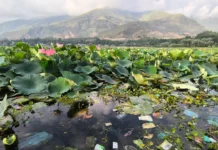
After the meeting, Gor spent an hour on a shikara near Nehru Park, escorted by embassy security. It was the kind of image policymakers have long wanted associated with the Valley: an American diplomat, relaxed and admiring the water, describing the place as beautiful and full of opportunity.
Advisory In Question
The more consequential part of Gor’s remarks concerned travel. The United States currently maintains a Level Four Do Not Travel advisory for Jammu and Kashmir, citing terrorism and civil unrest. Gor said Washington periodically re-evaluates such warnings and suggested this one could be reviewed, crediting New Delhi and the Jammu and Kashmir government for what he called incredible steps to make the region safer.
However, he stopped short of a firm commitment. “I cannot make any big announcements here today, but it is something we are going to look at,” he said. Even so, the suggestion alone carried weight. A downgraded advisory would matter enormously to an economy still recovering from the Pahalgam massacre of April 2025, in which twenty six tourists and a local resident were killed. Former Chief Minister Mehbooba Mufti had publicly appealed to Gor days earlier, describing the advisory as more than a warning, calling it a wall between Kashmir and the world.
Old Formula Dropped
To understand why six words caused a diplomatic storm, it helps to look back at how carefully Washington has usually chosen its language on Kashmir. For much of the Cold War, the United States leaned towards Pakistan’s position, supporting United Nations efforts. That calculation shifted gradually after the Cold War ended, particularly following the Kargil conflict of 1999, when President Bill Clinton placed blame squarely on Pakistan.
Still, even as ties with India deepened through the 2000s, US officials avoided saying Kashmir belonged to India outright. The standard formulation, repeated across administrations including in a 2020 Congressional document, held that Kashmir’s status should be settled through negotiation between India and Pakistan, taking into account the wishes of the Kashmiri people.
President Trump broke from caution in 2019 by repeatedly offering to mediate, an offer India rejected each time. Gor’s remark goes further than mediation talk ever did. It does not offer to help settle the mess.
Sindoor Shadow
Gor’s visit did not happen in isolation. Four days earlier, reports appearing in the media suggest, the documentary Declassified: Operation Sindoor premiered in India, detailing the 88 hour military response launched after the Pahalgam massacre. The film has irritated Pakistan’s military establishment, with the Director General of Inter Services Public Relations dismissing it as a dramatised, Bollywood style account. Pakistan’s response to that film and to Gor’s remark arrived almost together, and Islamabad’s establishment appears to be treating both as part of the same uncomfortable week.
Adding to the tension, Pakistan issued a notice restricting airspace across a wide stretch of territory on the very days of Gor’s visit, widely read as preparation for a missile test. A separate bout of tit-for-tat diplomacy has unfolded between the neighbours. Islamabad removed parking poles from the Indian High Commission and New Delhi reciprocated by removing queueing lines outside the Pakistani High Commission.
Reading the Signal
Kanwal Sibal, a former Foreign Secretary, offered a measured view. Talking to The Hindustan Times, he pointed out that every Indian state is, in a technical sense, an important part of India, but argued that Gor’s phrase carries weight precisely because of the long history of American caution on the subject. He also floated the possibility that Gor might have simply exceeded his brief, and that Washington might later revert to its usual careful language to placate Islamabad. He noted, too, that Gor’s role as envoy for the wider region, a portfolio that includes Pakistan, may now be complicated by Islamabad’s anger.
Michael Kugelman of the Atlantic Council read it differently, framing the comment as part of Gor’s consistent effort since January to repair ties with New Delhi after months of strain. But he raised the same question as Sibal from another angle: whether one comment reflects genuine policy or simply enthusiasm, and whether it risks unsettling a Pakistan relationship that Washington has worked hard to rebuild since the Munir and Sharif visits to the White House in 2025.
“Seventy-three years ago, American emissaries came to the Valley to whisper the possibilities of independence to Sheikh Abdullah. On August 19, an American ambassador, with the Sheikh’s grandson standing beside him, seemed to have ended all ambiguity about the American position on Jammu and Kashmir,” Amitabh Matoo wrote in The Indian Express. “For decades, Washington dealt with Kashmir as if it were a problem in search of a permanent political resting place. In Srinagar earlier this week, it implicitly acknowledged that history had already made a choice.”
Kashmir Politicians React
Though Gor met only the Chief Minister, all politicians reacted to the outcome. Mehbooba Mufti was the sharpest critic. The PDP chief said foreign dignitaries visiting Jammu and Kashmir since 2019 have followed a tightly managed script. Before 2019, she said, ambassadors would meet people from every section of society. Now, she said, they meet only the Chief Minister and the LG, take a shikara ride, and leave.
Mufti also pushed back on the idea that Gor’s words carried any real weight for Kashmir. She said India did not need to take America too seriously, arguing that American intervention around the world has tended to bring destruction rather than good. America, she said, was not a master whose certificate Kashmir needed. She agreed with Omar that Washington cannot solve Jammu and Kashmir’s problems, asserting that task belongs to New Delhi.
When Omar Abdullah, the erstwhile MoS in External Affairs, was asked about Pakistan response, he kept his distance from the row. He called it a matter between Pakistan and America, saying neither he nor anyone in Kashmir could do anything about it. The American Ambassador had said what he said, Abdullah noted, and it was now for the two countries to sort out between themselves.
Congress leader Tariq Hameed Karra took a different line from Mufti, insisting Gor had said nothing unusual. Jammu and Kashmir has always been an integral part of India, he said, and the whole world knows this. But he argued that any third party weighing in at all, whether the US Ambassador or anyone else, reflected badly on New Delhi rather than validating Kashmir’s status.
Karra pointed to what he called ‘a failed policy’ under the present government, citing the high level of American involvement during Operation Sindoor as an example. He said Congress does not recognise any third party role in Kashmir, pointing to the Simla Agreement, and called Pakistan’s decision to summon the US envoy an internal matter for Islamabad alone.
CPI(M) leader Mohammad Yousuf Tarigami offered the most sweeping criticism, arguing that the United States has long been a threat to global stability. He cited Iraq, Libya, Venezuela, and Gaza as examples of what he described as American interference carried out either directly or through allies.
Despite their differences, a pattern runs through these reactions. Regional parties, whether critical of Gor’s words or dismissive of their importance, agree on one point. Kashmir’s future, they say, will be decided in New Delhi and not in Washington.
Ladakh Visit
A day later, Gor left for Ladakh. Initially, it was expected that he would meet the Dalai Lama. That meeting did not happen. Instead, he had white water rafting at the confluence of two desert rivers. On day two of his stay in Ladakh, he visited Thiksay and spent some time with the managers. One of the monks told reporters that the visiting dignitary was interested in the history of the monastery and the basic tenants of Buddhism.
By the time, this report was filed, there was no detail about any of the important meeting that visiting envoy may have had in the arid desert region. Even the LG of the UT was in Delhi.
Regardless of what Gor does in Ladakh, his success in getting the travel advisory downgraded would be far more consequential for Kashmir’s economy than his other remarks are likely to be for history.