With railway lines now connecting Srinagar to Katra and beyond, and a new bypass on the National Highway diverting traffic away from Banihal, the highway town faces growing frustration over losing its historic economic advantage. Syed Shadab Ali Gillani spent a day in Banihal to report on the impact of a transformative infrastructure project set to make history.
For over a decade, Banihal thrived as the vital bridge between Kashmir and the rest of the country, its railway station buzzing with travellers eager to reach Srinagar in record time. The rhythmic hum of trains brought prosperity, convenience, and undeniable energy to this highway town. In the shadow of this transformation, Kachkote, once an isolated hamlet where few dared to tread after sunset, became a thriving hub after the establishment of a railway station, pulsing with life as thousands passed through daily.
But now, an air of uncertainty hangs over Banihal. With the rail moving forward to Reasi and then to Katra, bypassing the town, residents fear they may be left behind, the town fading into the margins of progress. The Kashmiri saying echoes in conversations across tea stalls and market squares, “Kasheereh banean watteh, Banihal gassie lateh” which translates to “while Kashmir will have access routes, Banihal risks being left in the dust.”
The town is facing a double trouble. For decades, it was also popular among travellers through the highway, and most of its market was directly or indirectly dependent on them. However, the situation has changed with the operationalisation of the new bypass, which circumvents the market. This is another significant worry for the people, especially those involved in the business and transport sector.
After emerging as a major halt station, owing to the railways, the real estate costs in the town skyrocketed. People who sold parts of their inheritance to the new road and railway projects, invested in businesses, which are now anticipated to take a hit.
A Hill Station
Nestled in the Pir Panjal range on the foothills of a ‘nightmarish’ pass, Banihal has a pleasant temperature with a consistent weather pattern throughout the year. Unlike Jammu, where summers can be hot, or Kashmir, where dense fog and harsh winters predominate, Banihal is comparatively temperate.
One of its most notable geographical features is the existence of three separate wind currents, particularly during the winter. As visitors emerge from the Jawahar Tunnel into Banihal, they are frequently met by brilliant blue skies, in stark contrast to the dismal weather they may have left behind. These winds are critical in keeping the sky clear, since warm air from Punjab collides with the Pir Panjal mountains, preventing heavy clouds from entering the town.
As an extension of Kashmir, Banihal has been there for ages. Its rise, however, started in the 1890s, when Maharaja Ranbir Singh ordered the construction of a Cart Road from Jammu to Srinagar via Banihal, providing the first structured effort to connect the two regions. This road was initially reserved for the royal family and high-ranking officials. A breakthrough came with the construction of a suspension bridge over the Chenab River at Ramban, further cementing the route’s importance.
The road remained exclusive for the durbar until 1915 when it was made motorable for Rs 40 lakh. The project saw the expertise of Pt Laxman Joo Tickoo, a Kashmiri engineer, who played a vital role in its development. In 1922, the Banihal Cart Road (BC Road) was finally opened to the public, marking a new era in Kashmir’s connectivity. Till then, the main highway for Kashmir was the Jhelum Valley Road (JVR) which took travellers from Srinagar to Muzaffrabad to Kohala and to Lahore.
With the opening of the Banihal Cart Road, the dreaded begaer system—a form of forced labour where resident subjects were made to carry goods and people across treacherous mountain passes—finally came to an end.
Despite its significance, the road had inherent limitations. The Banihal Pass (altitude: 2,832 meters) was a constant challenge. Heavy snowfall and frequent landslides disrupted movement, cutting off Kashmir from the rest of the plains for months at a time. It was clear that a more reliable, all-weather alternative was needed. The real major developments took place only after the partition.
In 1954, the government of India launched the Jawahar Tunnel Project, named after Prime Minister Jawaharlal Nehru. The project enlisted the expertise of German engineers Alfred Kunz and C Barsel, who undertook the challenging task of boring through the Pir Panjal mountains. After years of meticulous work, the tunnel was completed in 1956 and opened to traffic on December 22.
The Rise
The development of the Banihal Cart Road and the Jawahar Tunnel not only revolutionised connectivity between Jammu and Srinagar but also played a pivotal role in the growth of Banihal itself. Once a small and relatively obscure mountain pass, Banihal evolved into a key transit town, benefiting from increased trade, tourism, and infrastructure development.
Before the construction of the BC Road in the early 20th century, Banihal was little more than a halting station for travellers navigating the treacherous Pir Panjal mountains. During the Dogra rule, it served as a resting point for those making the long and arduous journey between Jammu and Srinagar. However, its remoteness made it an inhospitable place, limiting its economic potential.
With the opening of the BC Road in 1922, Banihal saw a steady increase in traffic. Inns, shops, and service centres began to appear along the route, catering to the growing number of travellers. The end of the Begaer system also allowed residents to engage in commercial activities, leading to economic upliftment.
The subsequent construction of the tunnel helped Banihal become a crucial trading post between Jammu and Srinagar. Local businesses flourished as goods, including agricultural produce, handicrafts, and construction materials, moved through the town.
The tunnel ensured the year-round movement of vehicles, leading to the growth of transport businesses, petrol stations, repair shops, and roadside eateries. With the ailing highway prone to disruptions, Banihal would be the first choice for people to take shelter. It was closer to Kashmir and cultural affinity added to the trend. Banihal is a Kashmiri speaking belt. The major flip came when the Qazigund Banihal railway line was inaugurated by Prime Minister Manmohan Singh in 2013. The link has to its credit the second longest tunnel constructed at the cost of Rs 16291 crore. It reduced the distance between Banihal and Qazigund by half — from 35 km by road to 17.5 km by train. Soon, the travellers started moving from Srinagar to Banihal in train and moving ahead through the transport supplied and managed by Banihal.
“When the train service started in Banihal it helped in the overall economy of the region and marked a significant improvement but now it is moving forward it will have an impact,” said a resident.
Banihal Business
While most of the Srinagar Jammu highway (NH44) was upgraded into a better road, the patch between Banihal and Ramban was quite a harsh task. Initially, nobody was willing to work on this slide-prone patch and this helped Banihal a lot. Now the patch was relaid.
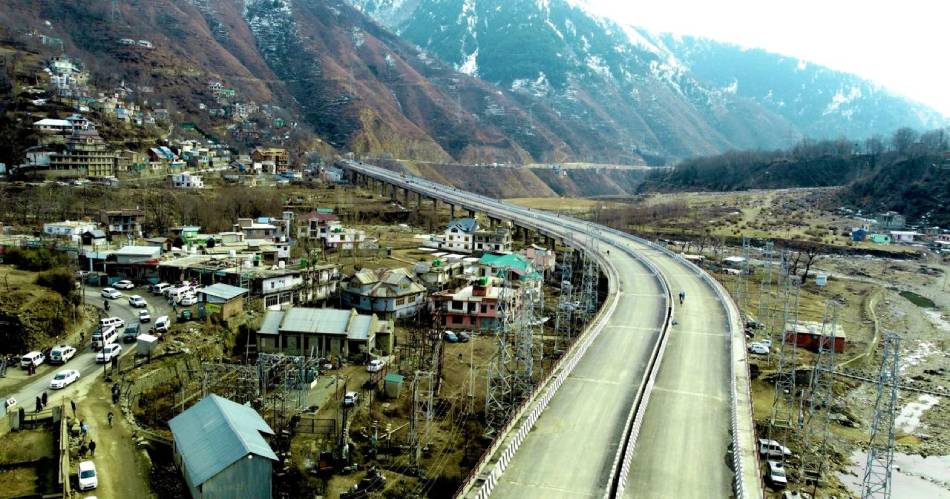
Recently, the National Highways Authority of India (NHAI) inaugurated a 2.2-kilometre-long bypass worth Rs 225 crores and now all the vehicles travelling to Jammu and other parts will not enter the Banihal market.
“We are happy to announce that Banihal bypass has been completed. Traffic on one tube has been allowed after the permission from Union Minister of Road Transport and Highways Nitin Gadkari,” the resident added.
Banihal’s once-bustling market, where honking cars and gridlocked traffic turned a short walk into an hour-long ordeal, now stands eerily open and congestion-free. The usual chaos has vanished, no blaring horns, no impatient drivers, no endless lines of vehicles. But beneath this newfound order lies an unsettling reality: business is suffering. Shopkeepers who once thrived on the daily rush now watch empty streets with growing anxiety, wondering if the silence signals the slow decline of their livelihoods.
Concerned Traders
Parvez Ahmad Wani who runs his family-owned dhaba in the Gund area of Banihal said that the eatery was managed by his father for 45 years and that he himself has been working there for more than 38 years. He said that Banihal is considered as the gateway of Kashmir but the construction of the New Bypass has affected the business in the area at a massive level.
“There was a time when I had eight employees here but now the number has reduced to just one,” Parvez said. “The rest of the staff was cut down. The new Bypass not only affected my livelihood but the livelihood of so many other people. This market was home to 120 shops approximately out of which 95 were shut down.”
“Everyone is now sitting at home idle. The workload has also decreased from 100 per cent to just five per cent. All the customers are locals and not travellers. Everything has changed now. And once the train starts running, even these five per cent customers will be gone, Banihal is moving back to the 1970s when it was very downtrodden,” Parvez regretted.
When asked about the solution to this problem he said, “the only solution is to manage the traffic through our area so that our businesses do not suffer any further losses. One side traffic should play through Banihal that will help us flourish.”
Not only Parvez, but every other person who is associated with trade is worried and anxious. The town which was once surviving on small tea stalls, flourished because of the rail and the road project that led to massive investment, especially in real estate, but now they are again travelling back to the past.
“Since the construction of this new Bypass we have been rendered jobless,” Ahmed, another shopkeeper said. “All of our shops, and hotels, which will be more than 150 are now customer deserted. Because nobody visits our shops and hotels now.”
The main Banihal market, however, still holds ground, drawing shoppers from nearby villages and managing to sustain a fair share of business. But just a short distance away, Gund market tells a different story, a tale of decline and emptiness. Once a thriving hub of roadside eateries and mechanic shops catering to travellers between Kashmir and Jammu, it now stands eerily quiet. Shuttered storefronts outnumber the open ones, and those still in business serve only a trickle of locals. The bustling energy that once defined Gund has faded, replaced by an unsettling stillness that speaks of uncertain times ahead.
Gulzar Ahmad Mir who has been owning a shop in Gund for the past seven years said that the new Bypass has affected the workload tremendously. “There were days when I used to keep my shop open 24/7 but now there is no workload even during the daytime let alone at night. All of us have been rendered without a job. In the past everyone was happy since we had a good and flourishing business but now since these developments were made everything has changed. We all are heartbroken and left in despair.”
Mir said the road was the only source of earning livelihood but now it is lost. “The train will prove to be the last nail in the coffin. Banihal is moving towards the 1950 era when this place was very remote. Banihal market especially the Gund market has shut down because of this new 4 lane bypass,” he said.
Mohammad Asif, another shop owner, said that 85 per cent of the market is suffering from losses. “We request the government to provide a link road so that a few vehicles play through our markets too,” he said. “We have no industries, no colleges nothing where our youth can study or like work at.”
Nazir Ahmad a hotel owner near the railway station Banihal said that the people of the area are very poor and depend on the railway station, sumo station, bus stand for jobs. But now if the train goes directly, the town will suffer. He said the twin intervention – the road and the rail – will render hundreds jobless.
Transporters
After the train halted, the roaring business was the transport. Since the town was not in a position to manage the entire transport, people from Ramban, Doda, and Anantnag would operate their vehicles from Banihal. Hundreds of residents applied for loans and purchased new vehicles. They all are worried now.
“The direct railway line threatens to decimate our economy. The majority of the youth will be left jobless. More than 800 families rely on these jobs for their livelihood,” Asif Ahmad Bhat, a local contractor who manages the parking of the Railway station bus stand said. “The railway line will affect the transporters the most. The shopkeepers, restaurant owners, hotel owners and everyone will be affected.” He hoped the transporters would now look for spaces where they have work and it is not Banihal.
Pawan Sharma, a transporter from Jammu said that they have invested a lot of money in buying these vehicles. “If there are no passengers how will we be able to pay back our loans and debts,” Sharma said. “We would have to surrender our vehicles. Both Banihal and Jammu will suffer losses. We will die of hunger. And that will also increase the criminal activities because there will be no other alternative for all those who are in debt.”
Another transporter from Jammu who wished to stay anonymous has been travelling on this route since 2014. “Nobody from this stand returns empty hands but now it has created a sense of fear among us and if you look around everyone is worried because they have a family to run.”
Another Jammu-based transporter said, “Initially it will be a mess for us but eventually everything will be fine. People love to experiment with new things and for the first few months they will travel by train but eventually, they will come back to road transport,” he said with a confident smile. “There is no direct train to Jammu or Delhi passengers have to deboard at Katra station and it is something that people in this fast moving world do not like, people are always in rush and by road it takes just five hours to reach Jammu which is a positive sign for us.” In that case, he said, the fares will go down and margins will reduce.
Political Viewpoint
DDC Imtiyaz Ahmad Khanday said Banihal residents, especially local businesses, are facing severe hardships due to the new four-lane national highway. The town feels completely disconnected from the main road network, leading to a significant decline in business. There is an urgent need for alternative connectivity options, especially for emergency services.
“We have connectivity outside Banihal, which can lead to some untoward incidents,” Khanday said. “We want connectivity in Banihal. We are hopeful the government understands our demands. We are demanding everything very politely because we are suffering. We also request Kashmiri truck drivers to play through our area.”
Ecological Concerns
The Banihal-Ramban stretch of the Jammu-Srinagar highway, a vital yet treacherous lifeline, continues to be a source of anxiety and concern. Winding through fragile terrain, this 36-km stretch has long been plagued by landslides, and structural collapses, and has a tragic history of accidents. Among its frightening landmarks is the Khooni Nallah tunnel collapse, a disaster that claimed 10 lives in May 2022.
A three-member expert committee, led by IIT Delhi’s Prof JT Shahu and appointed by the Ministry of Road Transport and Highways (MoRTH), is probing the incident, hoping to uncover the failures that led to the catastrophe. While compensation has been promised to the bereaved families, no amount of money can mend the wounds left behind.
On the night of May 19, 2022, a portion of the newly started Adit tunnel between Digdole and Khooni Nallah caved in, trapping 13 workers. Three were rescued, but 10 others lost their lives. The stretch remains the most daunting part of the highway project. Initial plans to widen the existing road were abandoned in favour of a new 13.6-km alignment featuring tunnels, viaducts, and bridges to bypass hazardous stretches. However, the region’s fragile ecology and complex geology continue to challenge engineers and contractors, as highlighted by delays, collapses, and abandoned works in both highway and railway projects.
As progress continues on the highway and rail projects, the fundamental challenges of the region remain unchanged. Located in seismic zone IV, the area is marked by a major fault line near the Baglihar dam. Its young, fragile mountains are highly susceptible to erosion and instability.
A Division of Kashmir
In his book Banihal: Gateway of Kashmir, Manshoor Banihali notes that Banihal, historically an integral part of Kashmir, remained a pargana (administrative division) of the region until the early 17th century. According to Abu’l-Fazl, Banihal was included in the Shahabad (Deer) pargana, whereas William Moorcroft referred to it as pargana Ban Ilmi. Several surrounding villages, including those in Qazigund, were also administratively linked to Banihal.

Geographically and culturally, Banihal is deeply connected to Kashmir, stretching from Uri in the west to the Banihal mountains in the southeast. By the 17th century, the boundaries of erstwhile Kishtwar’s state extended to Banihal under the rule of Raja Bhagwan Singh (1636-1650), a courageous leader who expanded his territory with the help of his allies, ultimately bringing parts of Banihal under his dominion.
Manshoor further notes that Banihal largely remained an integral part of Kashmir, culturally and demographically. The people of Banihal shared strong linguistic and social ties with Kashmiris, as observed by British traveller Charles Bates, who noted Banihal’s status as a pargana of Kashmir during Emperor Akbar’s reign. Throughout history, Banihal also served as a refuge for Kashmiri rulers and tribal leaders escaping oppression or political turmoil.
The region’s governance changed hands multiple times, with rulers from different dynasties leaving their mark, including Kashmiri, Kishtwari, and other tribal leaders. By the late 18th century, Banihal continued to be shaped by its Kashmiri heritage, with its customs, traditions, and language deeply influenced by the valley’s rich cultural history. Even historical shifts in power did not diminish its Kashmiri identity, making Banihal a testament to the region’s enduring legacy. Now it is awaiting a new shift dictated by the loss of an advantage. How the town will manage its small economy in the coming days remains to be seen.