In Jammu and Kashmir’s borderlands, relentless shelling has reduced homes to rubble and lives to grief. Villages lie in ruins, survivors mourn their dead, and local leaders demand bunkers and basic aid for those still trapped in the conflict, reports Syed Shadab Ali Gillani
Twelve years ago, Urusa and Rameez’s lives overflowed with happiness as they welcomed twins, a daughter, Urwa, born first, followed five minutes later by her brother, Zain. However, twelve years on, that same five-minute gap became a cruel reminder of fate. A shell struck their hometown in Jammu and Kashmir, claiming Urwa’s life, and five minutes later, Zain followed. The twins who entered the world together were laid to rest together, wrapped in white shrouds, side by side, leaving their parents engulfed in indescribable grief.
Rameez, who himself sustained fatal injuries, remains unaware of his children’s fate. He has been told they are safe and staying with a relative. It was Urusa who had to endure the heartbreak of sending her children off. She remains in shock, silent, unable to speak. At home, the siblings were lovingly called Ayan and Zoya.
Grief Beyond Words
The tragic incident occurred in the early hours of May 7 in Poonch. The family was attempting to evacuate to safety when the shell struck. Urwa held her mother’s hand, while Rameez held Zain when a shell hit them. The blast hurled the twins in opposite directions, leaving them grievously wounded and bleeding profusely. Zain’s stomach was torn open, while Zoya lost a significant amount of blood.
By the time they reached the hospital, both children had died. “The incident happened outside their two-room rented accommodation, near the school where both studied,” a resident recounted. The family had moved from their ancestral village of Kalaani Chakthru to Mandi in the Poonch district to provide a better education for their children.
Minutes before the shelling, Zoya had urged her brother to pray. “What if we are hit and die? Let us offer namaz,” she said. A local who witnessed the events recalled this heartbreaking detail.
Urwa and Zain were among the five children who lost their lives in the shelling. The others were seven-year-old Maryam, two-year-old Aisha (a non-local), and thirteen-year-old Vihaan.
Collateral Damage
Seven-year-old Maryam was a student of UKG. She lived in a tin shed that her family called home, and it was there that she breathed her last.
“Maryam passed away, while her sister was injured,” said a close relative. “Ambulances arrived, but the chaos was such that we could not even pick up her body. It is our loss. Amid what happened between India and Pakistan, a seven-year-old child lost her life.”
For three hours, Maryam’s lifeless body lay untouched. There were no facilities available. Her family had migrated from Qasbah to Sukha Kattha, hoping to escape the relentless shelling that had disrupted their children’s education. But the place they sought as a haven became the site of Maryam’s death.
Outside the tin shed, two animals, a cow and her calf, lay dead. They had been left behind by their owners, who had fled to safer ground.
“A shell killed the cow,” said a local. “Her body lay there for days because no one was here. The calf was also hit, and dogs ate its body.”
Life Misrepresented
A few kilometres away, 46-year-old Qari Mohammad Iqbal, a teacher at Madrasa Zia-ul-Uloom in Poonch, was killed. His death carried further cruelty, a false narrative that branded him a terrorist.
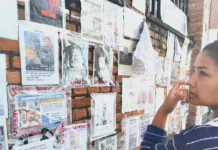
Iqbal lived in Baila village in the Mandi Tehsil of Poonch. News of his death spread with a photograph and a headline claiming he was a terrorist gunned down by Indian forces across the Line of Control. The story was widely circulated in national media until the police in Poonch issued a clarification, refuting the false reports. No FIRs, no arrests.
Iqbal had been a teacher for over two decades. “He was at work when he was hit,” a family member said. “He was a Hafiz e Quran. But the media was dirty. We are angry and hurt.”
The family was informed of his death through a phone call. “A relative called and told us. We rushed to bring his body home,” the family member continued. “We also evacuated some relatives stranded in the shelling. The next day, news channels were running a false story, accusing him of something that was a complete lie. Those headlines rubbed salt into our wounds.”
Iqbal is survived by eight children, one of whom is handicapped. The family is struggling to come to terms with his death and the false accusations that followed.
“When he was injured, Pradeep Sharma, a former MLC, took him to the hospital,” another relative said. “Iqbal breathed his last in Sharma’s arms. The grief will stay. People have been sending us clips of the news terming him a terrorist. It has broken our hearts.”
Human Cost
Amarjeet Singh, 52, was a retired army officer from Poonch. He came from a family known for its social activism. On May 7, as his uncle returned home after rescuing the injured, he had no inkling that tragedy would soon strike his own family.
Amarjeet was in his compound when a shell’s splinters struck his body, piercing multiple areas, including his lungs. Despite his injuries, he walked to the hospital but succumbed hours later.
“Doctors tried to save him,” a family member said. “But his lungs had already ruptured. There was nothing they could do.”
In the Poonch district alone, over 200 people were injured, and 14 people, including five children, lost their lives. Across Jammu and Kashmir, more than 21 people were killed as shelling intensified in what residents described as a war-like situation.
Festivities, Funerals
Not far away, as the crow flies from Poonch, the town of Uri bore witness to more death and destruction. Nargis, 44, was fleeing with her family when a shell hit the vehicle they were travelling in. Ten members of her family were inside. Nargis, a mother of six, died on the spot, bleeding to death.
She had been preparing for her daughter’s wedding, scheduled for the following month. The air that should have carried the sound of music and celebration now echoed with cries of grief.
“We lost everything,” Nargis’s daughter said, her voice trembling. “Please bring our mother back,” she screamed, sobbing.
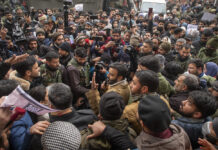
In her final moments, the family said, Nargis had asked for water, but none was available. The ambulance driver who transported Nargis and the injured to the hospital suffered a severe anxiety attack upon reaching the hospital. “It is always the civilians who bear the brunt of the war,” said a neighbour, watching the mourning family.
Dreams to Dust
In Karnah, the loss was not of lives but of dreams. A day before his daughter’s wedding, Nazir Ahmad Mir of Hajinar village watched helplessly as shelling destroyed his home. Years of savings and months of planning for his daughter Bisma’s wedding crumbled to nothing.
“The house is fully damaged,” Nazir said, staring at the rubble. “Everything we had prepared for the wedding is gone.”
Nazir was not alone. The shelling in Karnah destroyed more than 460 homes. Livestock was lost, shops lay in ruins, and people were left standing amidst the debris of their lives. “Shops, homes, properties, everything has turned to rubble,” said a resident. “Countless dreams were destroyed.”
View this post on Instagram
Bunkers
MLA Poonch, Ajaz Jan, believes the loss of life could have been lessened if there had been bunkers.
“We have been appealing for permanent bunkers for years,” he said. “Poonch is extremely vulnerable. If we had bunkers, the loss would have been considerably less.”
“Everyone is a victim here,” he asserted. “The locals, the frontline workers, the administrative staff, everyone is suffering and continues to suffer.”
Cry for Water
In his constituency, 14 people lost their lives, and between two hundred and three hundred others sustained injuries. Even the supposedly safer villages were not spared, said MLA Poonch, Ajaz Jan.
Jan recounted the desperation of survivors. “An old man kept repeating, ‘We want nothing but water. Please give us water,’” he said.
Jan added that those employed on a need basis were suffering without pay. “I do not even have a bulletproof vehicle,” he said. “We are all victims here, the dead, the injured, the homeless, the abandoned. Everyone is a victim.”
He expressed frustration over the exodus of those with resources, leaving the locals to fend for themselves. “Domicile holders ran away. State Subject holders stayed behind,” he said. “Those who were advocating for war are nowhere to be seen. It is the locals, the frontline workers, who have borne the brunt.”
Compensation
Jan said the government had begun distributing compensation to the families of the deceased. “Six lakh rupees were paid without any formalities. We will give them four lakh more,” he said.
The Chief Minister had also promised to try and secure an additional Rs 10 lakh, he added. “The injured will be compensated as well. We are currently assessing the damage,” he said.
The situation in Poonch was exacerbated by its topography, Jan said. “We are in a low-lying area, an easy target for shelling,” he said. “We had no vehicles, no bunkers, nothing.”
The impact was severe. “Students spent everything they had to pay bus fares to return home,” he said. “Daily wagers, street vendors, panchayat members, everyone is a victim. They exhausted all their savings trying to survive.”
View this post on Instagram
Desolation
The devastation in Uri was extensive. MLA Uri, Dr Sajjad Shafi, said that around 460 houses had been affected. “Nearly two hundred are destroyed, and the rest are partially damaged,” he said.
“People are living in constant fear,” he said. “There is a strong demand for bunkers, individual and community.”
Shafi said the last time bunkers were provided was in 1998, when his father was the finance minister. “After that, everything was lost in the earthquake. Since then, no new bunkers were built,” he said. “Today, we have only one or two community bunkers, which are not enough.”
Rehabilitation
“This loss is not of our making,” Shafi said. “It is the result of a conflict between two nations.”
One civilian had died in Uri, and 15 others were injured, five of whom remained hospitalised. The government announced Rs 10 lakh in compensation to the family of Nargis, who lost her life in the shelling.
“The scale of damage is still being assessed,” Shafi said. “I urge both the Jammu and Kashmir government and the Government of India to open their hearts and truly rehabilitate us.”
Shafi underscored the urgency of building bunkers. “If we had bunkers here, we would not have seen this much loss of life. We would not have seen so many people evacuated,” he said.
“More than fifty thousand people fled towards Baramulla,” he said. “That is not a small number.”