The Jammu and Kashmir government has set a one-month deadline to finalise an ambitious new Public-Private Partnership policy framework, writes Masood Hussain
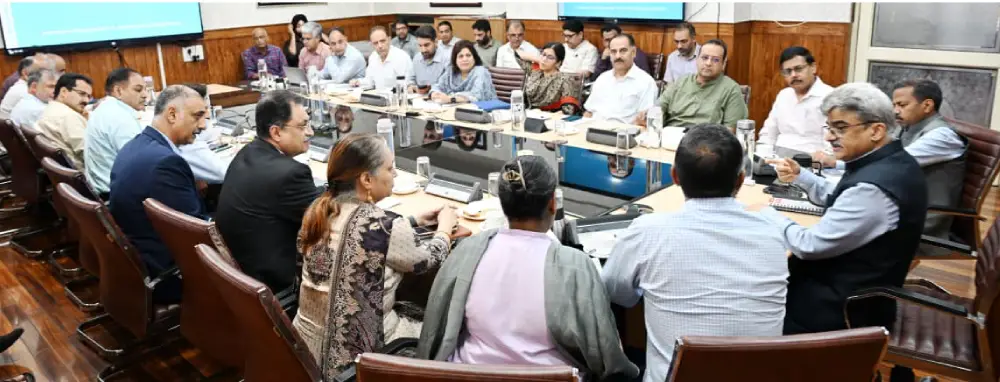
The Jammu and Kashmir government is developing a Public-Private Partnership (PPP) policy through the Centre for Innovation, Technology and Governance (CITaG) with the stated objective of creating an enabling ecosystem for private investment and accelerating infrastructure and public service development. Chief Secretary has asked the industries department to refine the existing policy draft and make it a comprehensive and well-structured policy document within a month.
The Policy
At its core, the framework is built around a single ambition: to reduce the government’s dependence on public exchequer funds for infrastructure while positioning Jammu and Kashmir as a preferred destination for domestic and global investors. Officials say the policy’s stated vision is to maximise the efficiency of government spending, leverage private capital, and turn local aspirations into well-managed infrastructure that visibly improves daily life.
Four objectives anchor this vision: attracting private investment, prioritising projects with high local employment potential, driving economic growth and per capita income, and protecting Jammu and Kashmir’s forests, rivers, glaciers and biodiversity through every project undertaken. Officials say these objectives are meant to be read together, not as a checklist to be traded off against one another.
The policy is also built on six operational principles, according to officials aware of the framework’s contours: shared risk between public and private capital, a citizen-first orientation to service delivery, life-cycle cost efficiency, transparent and open bidding, in-house capacity building within departments, and explicit protection of J&K’s social fabric and heritage in every project that goes to the private sector.
The policy scope is wide. The policy is expected to apply to sectors on the Government of India’s Harmonised Master List, which includes roads and bridges, urban infrastructure and water supply, ports, airports, railways, energy and power, tourism and hospitality, healthcare and education, agriculture and food processing, solid waste management, and ICT infrastructure. It will cover not just administrative departments but public sector undertakings, urban local bodies, development authorities such as the Jammu and Srinagar Development Authorities, and government-controlled special purpose vehicles. It, however, excludes routine EPC contracts, standard outsourcing arrangements and government-to-government contracts.
Governance under the policy is structured as a multi-tier chain of command, officials said: the Cabinet and LG retain final policy authority; a Jammu and Kashmir Empowered Committee, chaired by the Chief Secretary, sits as the apex inter-departmental appraisal body; department-specific PPP Evaluation Committees handle bid appraisal at the sectoral level; the PD&MD’s PPP Cell functions as secretariat and transaction adviser; and Project Sponsoring Authorities carry projects from identification through to monitoring. A Grievance Redressal Committee, chaired by the Administrative Secretary of PD&MD, is meant to address disputes arising from the bidding process.
Financing is proposed to draw on three instruments working in tandem: the Centre’s India Infrastructure Project Development Fund for transaction advisory costs, a Jammu and Kashmir Project Development Fund of Rs 5 crore for feasibility work where central funding is unavailable, and a Jammu and Kashmir Viability Gap Funding corpus of Rs 100 crore designed to supplement central VGF support and be applied for simultaneously to cut delays, officials said.

In Support
Officials making the case for the policy point first to the scale mismatch between Jammu and Kashmir’s infrastructure needs and its public finances. Roads, urban services, tourism assets and logistics networks, they argue, require capital and technical expertise beyond what government budgets alone can sustain, a gap they say only private participation can realistically close. The push is also framed as consistent with the National Infrastructure Pipeline and the Centre’s Viksit Bharat 2047 vision, giving Jammu and Kashmir projects a route to central funding streams and national visibility through an NIP identification number.
In a recent meeting, the Chief Secretary cited the World Bank’s STEP model as a template worth adapting. The dynamic, self-evolving framework, he said, allows efficient project execution with minimal procedural friction.
ACS (Finance) told the meeting that the policy’s overarching purpose is to leverage private investment for public asset creation and quality service delivery. At the same time, he insisted that any borrowing from national and international best practice must stay rooted in Jammu and Kashmir’s specific developmental context, challenges and opportunities.
The presentation made to the meeting also proposed a streamlined regulatory pathway including faster statutory clearances, environmental approvals and other mandatory permissions. This, they said, is aimed at making the investment process more predictable and less cumbersome for prospective investors. A defined approval matrix, running from Administrative Secretaries up to the Cabinet depending on financial thresholds, is meant to prevent decisions from stalling indefinitely in the bureaucracy, while a ten-step transaction lifecycle – from concept note to concession agreement signing – gives project sponsors a standardised, time-bound process to follow, rather than an ad hoc one.
Officials also emphasise that the government intends to lead by example in implementation, arguing that visible follow-through on the ground is what will build confidence among both investors and the public, a point the Chief Secretary underlined repeatedly during the deliberations, according to those present.

The Flip Side
For all its ambition, the policy carries risks that officials and observers of Jammu and Kashmir’s administrative history will recognise. Chief among them is the gap between framework and follow-through: J&K has seen investment-friendly policies before that struggled at the implementation stage, weighed down by procedural delay, inter-departmental friction and shifting priorities. A ten-step transaction lifecycle and a multi-tier approval matrix running from Administrative Secretary to Cabinet may bring structure, but they also multiply the number of authorities a project must clear. It is a built-in tension between the policy’s promise of speed and its own layered clearance architecture.
The financing instruments, too, invite scrutiny. A Jammu and Kashmir Viability Gap Funding corpus of Rs 100 crore and a Project Development Fund of just Rs 5 crore are modest sums against the scale of infrastructure the policy envisions across eleven sectors spanning. This raises the question of how many projects such funds can realistically support before the government must lean again on central approvals it cannot fully control.
The Grievance Redressal Committee, positioned as the safeguard against disputes in the bidding process, is notable for what it cannot do: its directions are explicitly suggestive rather than binding. Interestingly, it convenes only once every 90 days or at its chairman’s discretion, a cadence that may struggle to keep pace with time-sensitive commercial disputes.
Environmental and heritage safeguards are written prominently into the policy’s objectives and into a mandatory four-step environmental clearance process routed through the Centre’s Parivesh portal. But Jammu and Kashmir’s fragile ecology means that private participation in sectors like tourism, hospitality and urban infrastructure will inevitably test how firmly these safeguards hold once investment pressure builds. Officials acknowledge the policy’s own principles that PPP projects must preserve Jammu and Kashmir’s social fabric and historical identity, but principles of this kind have historically been difficult to enforce against commercial timelines once contracts are signed.
There is also the employment promise to weigh. The policy commits to prioritising projects with high local employment generation, but offers no enforcement mechanism disclosed so far to ensure private concessionaires actually hire locally once agreements are in place.
What Next
The last meeting concluded with a consensus to refine the draft further by incorporating suggestions received from various departments, and to evolve what officials described as a comprehensive, transparent and investor-friendly PPP framework capable of unlocking private investment and accelerating infrastructure development. The Industries Department has been tasked with finalising the document within a month, while CITaG has been directed to simultaneously identify a pipeline of viable projects and build the institutional mechanisms needed to execute them once the policy is notified.
Whether the policy delivers on its stated ambitions or joins the list of well-intentioned frameworks that stalled at the implementation stage will depend on far more than the document itself. Its success will ultimately rest on how faithfully the institutional machinery it creates is allowed to function once investors begin putting money on the table.