The emblem controversy at the renovated Hazratbal Shrine reignited Kashmir’s enduring tensions between faith and politics. Revered as the resting place of the holy relic, its sanctity ensures that any dispute resonates deeply, transforming sacred space into a theatre of conflict, reports Babra Wani
On September 5, 2025, when the renovated Hazratbal Shrine reopened its doors to worshippers, what was meant to be a moment of celebration quickly turned sour. Among the new features unveiled, one detail drew immediate unease: the Ashoka emblem inscribed on the inauguration plaque. What began as murmurs of disapproval soon swelled into open anger. Within hours, virtual protests erupted, with many calling the installation an intrusion into a sacred space and a violation of Islamic sensibilities.
The tension boiled over when an irate crowd defaced the emblem. Videos of the act spread rapidly across social media, fueling fresh waves of outrage and debate. Anger spilt onto the streets, and political leaders weighed in, with the focus quickly shifting to the Jammu and Kashmir Waqf Board, the body responsible for managing Hazratbal and other shrines across the Valley.
Waqf Board chairperson Darakhshan Andrabi condemned the vandalism in the strongest terms, describing it as “nothing less than terrorism” and “a grave insult to the shrine.” She urged the Prime Minister, the Home Minister, and law enforcement agencies to ensure the immediate arrest of those involved. Andrabi alleged that the unrest was not spontaneous but “deliberately engineered by political workers and their supporters.”
Chief Minister Omar Abdullah, however, struck a different note. Speaking to the media, he questioned the very decision to install the emblem in the first place. “I have never seen the Ashoka emblem in any religious institution or function before. Why was there a need to put up such a stone? If the work was good enough, people themselves would have recognised it,” he said.
Omar invoked his grandfather, Sheikh Mohammad Abdullah, who oversaw Hazratbal’s expansion in the 1960s. “He never felt the need for plaques or emblems. Even today, people remember his contribution without a nameplate. That shows the stone was never required,” he observed.
Reacting to Andrabi’s demand that the Public Safety Act be slapped on those who damaged the emblem, Omar replied, “First, people’s sentiments were hurt. An apology should have been offered, but no one did that. The emblem is meant for government offices, not for religious institutions — whether a temple, mosque, or shrine.”
In the aftermath, the Jammu and Kashmir Police registered an FIR over the defacement inside Hazratbal. Media reports suggest more than fifty people have since been detained, prompting opposition leaders to call for their immediate release.
The controversy unfolded barely forty-eight hours after Andrabi had formally inaugurated the shrine’s refurbished interiors as part of a major beautification project. The renovation included intricate gold carvings, traditional papier-mâché panels, Khatamband ceilings, Pinjrakari latticework, and new sound and digital systems. It was the first large-scale overhaul of Hazratbal since 1968, but its promise of revival has now been overshadowed by a storm over a single plaque.
A Place for Believers
For Shabnam, a 49-year-old resident of Srinagar, Hazratbal is more than a shrine; it is a sanctuary of the heart. Every Sunday for the past two decades, she has walked through its gates, offered namaz, and then lingered on the lawns, soaking in the quietude. “It gives me a sense of belonging,” she said softly. “This place, at the very least, should never be dragged into controversy.”
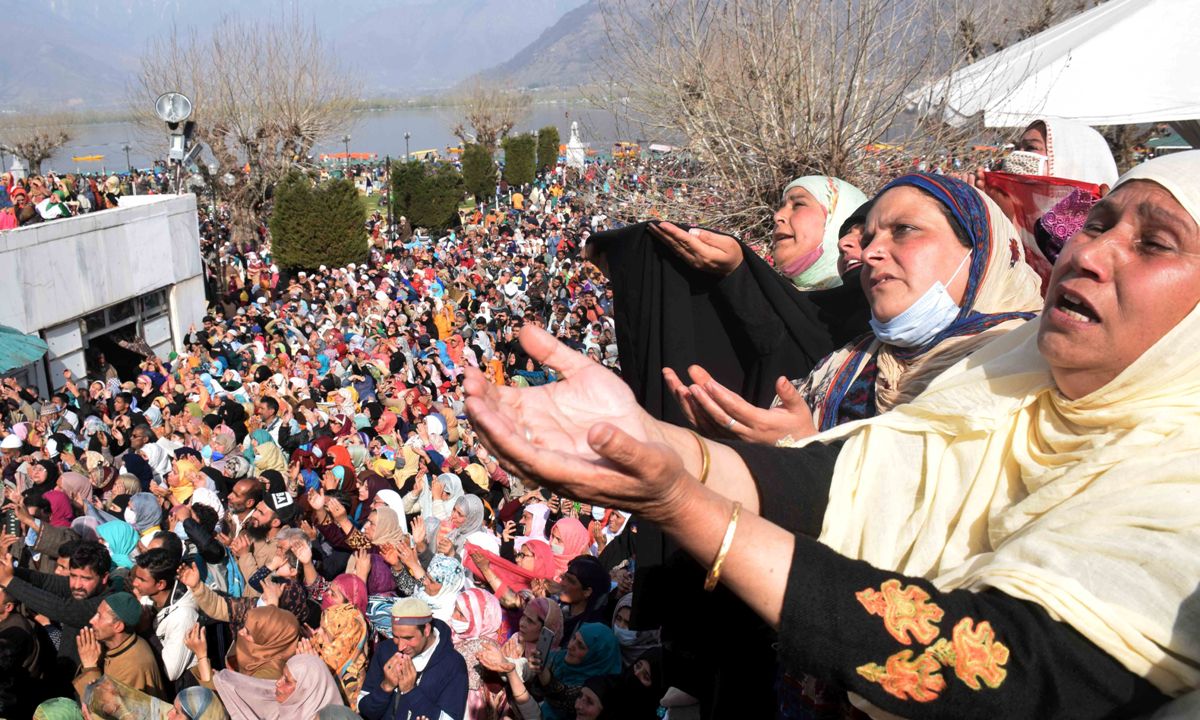
That sentiment is widely shared. Hazratbal is not only Kashmir’s most sacred Muslim shrine but also one of its most frequented social and spiritual spaces. Pilgrims and tourists come year-round, drawn as much by devotion as by tradition. Families arrive for picnics under its gardens, while others visit to perform the sacred ritual of Zar Kasai or Mundan, the first haircut of a newborn, believed to carry divine blessing when done at Hazratbal. “All the children born in our family over the last thirty years have had their first haircut here,” said a resident from Baramulla, recalling how the ritual has bound generations to the shrine.
The shrine’s grounds are interwoven with everyday life events. Just beside the white dome lies a garden popularly called Taqdeer Park, where couples and families gather to mark the baat pakki ceremony, sealing a marriage alliance under the shadow of the holy relic. To many Kashmiris, Hazratbal is not only a sacred monument but also a stage where faith, family, and community intertwine, a space where the spiritual and the social merge seamlessly.
The Significance
Dargah Hazratbal houses the holy relic believed to be a hair strand of Prophet Muhammad, making it Kashmir’s most sacred Muslim site.
The journey of the revered relic to Kashmir traces back to Syed Abdullah Madani, a descendant of the Prophet, who brought it from Medina to India around 1635. After his death, his son Syed Hameed inherited the relic but, anxious about its safety during the turbulence of Mughal conquests, entrusted it to a wealthy Kashmiri trader, Khwaja Nur-ud-Din Eshai. News of this sacred trust reached Emperor Aurangzeb, who ordered the relic to be seized and Eshai to be imprisoned in Delhi. Tradition holds that Aurangzeb, after experiencing a dream in which the Prophet directed him to restore the relic, relented. By then, however, Eshai had died in captivity.
Around 1700, the relic was finally brought to Kashmir, accompanying Eshai’s remains. Custodianship passed to his daughter, Inayat Begum, who enshrined it at the lakeside mosque that would become Hazratbal. Since then, her descendants, the Banday family, have served as the formal custodians of the relic, safeguarding it and overseeing its rare and deeply moving public display on the most significant occasions in the Islamic calendar.
Architecture
The Hazratbal Shrine, as it stands today, is the product of nearly four centuries of transformation, blending Mughal ambition, Kashmiri devotion, and modern interventions. Its current form took shape in 1968, when Sheikh Mohammad Abdullah, then head of the Muslim Auqaf Trust, oversaw the construction of a grand new structure. Completed in 1979, the shrine’s gleaming white marble facade, crowned with a single sweeping dome, set it apart as one of the most recognisable religious landmarks of Kashmir.
Yet the site’s history reaches back much further. In 1623, Shah Jahan’s subedar, Sadiq Khan, built a pleasure garden here, known as Ishrat Mahal. Just over a decade later, in 1634, the emperor ordered that the palace be converted into a place of prayer.
By the end of the century, when the sacred Moi-e-Muqqadas, the holy relic believed to be a hair of the Prophet, arrived in Kashmir, Hazratbal became its permanent home, elevating the site into the Valley’s spiritual centre. Initially housed at Naqashband Sahib, the relic was later enshrined at Hazratbal, drawing worshippers in numbers that steadily grew over the centuries. Friday prayers filled the mosque’s lawns, but the crowds multiplied dramatically during the special occasions when the relic was displayed for public deedar.
Architect and scholar Sameer Hamdani has often noted how Hazratbal’s design carries the unmistakable imprint of Mughal aesthetics. The Taj Mahal served as a reference point, explaining the use of milky white marble, the soaring dome, and the symmetrical arches. Unlike older Kashmiri shrines, usually modest wooden structures by rivers or nestled in neighbourhoods, Hazratbal presented itself as a deliberate departure, a Mughal-inspired statement that aligned Kashmir’s most sacred relic with imperial grandeur.
Through the decades, the shrine has undergone several renovations, though the exterior has remained remarkably consistent, preserving the original marble-clad profile. Interiors have been restored at intervals, with occasional adjustments to the dome’s finishing, but always with respect for the earlier design. The first significant overhaul came in the 1960s and 70s under Sheikh Abdullah’s watch, when the marble structure replaced the earlier mosque.
Between 2014 and 2017, a new wave of restoration sought to balance tradition with modern needs. Under a Waqf Board-led beautification project, artisans revived Kashmiri craft traditions, khatamband ceilings, delicate pinjrakari latticework, and gold leaf carvings, while engineers fitted the shrine with digital sound systems, air conditioning, and CCTV surveillance. The most recent renovation has further polished its interiors, reopening them to worshippers in a refreshed yet familiar form.
Salim Beg of INTACH, a conservationist, pointed out one detail that makes Hazratbal unique among Kashmiri mosques: its perfect alignment with the Qibla, the direction of Mecca. This architectural precision, he noted, is particularly striking in a landscape where homes and shrines were often shaped by terrain rather than geometry.
Historians underline that Hazratbal was always destined to be the chosen home for the relic. In Srinagar’s crowded historic quarters, no other structure had the scale or stature to enshrine the Moe Sharif. While shrines such as Dastgir Sahib or Naqshband Sahib honour revered saints, Hazratbal alone was elevated to carry the Prophet’s relic, making it not only a site of architectural beauty but also the beating heart of Kashmiri Islam.
Though archival blueprints and precise measurements from its early years remain absent, documentation was rare in the seventeenth century; the shrine’s significance was never in doubt. For Kashmiris, Hazratbal’s marble dome against the backdrop of Dal Lake and the Zabarwan hills has long been more than stone and mortar. It embodies a sacred trust, a spiritual anchor, and a cultural symbol whose presence is felt as much as seen.
The Controversies
The Hazratbal shrine is more than a place of worship. It is a cornerstone of faith and identity in Kashmir, and its centrality means that even the faintest controversy surrounding it has the power to swell into a storm. Two episodes in particular, the theft of the holy relic in 1963 and the siege of 1993, seared themselves into collective memory, reshaping politics and faith in the Valley.
On the frigid night between December 26 and 27, 1963, Kashmir awoke to a shock: the Moi-e-Muqaddas had vanished from Hazratbal. The wooden box that held it was found missing after the last public viewing on December 20, when Abdul Rahim Banday, the shrine’s senior custodian, had dutifully placed it back in its chamber.
The news travelled like fire through snow. Even in the biting winter, people poured out of their homes and gathered at the shrine. By afternoon, Srinagar’s streets had filled with tens of thousands demanding the relic’s immediate return. A spontaneous shutdown followed, shops shuttered, offices closed, and processions waving black flags surged towards Lal Chowk.
An eyewitness still remembers how ruling party workers tried to calm the masses but were driven back, pelted with kangris, the earthen fire pots Kashmiris carried to fight the cold. Protesters stormed through the city, some even attempting to attack the Radio Kashmir Srinagar.
The panic reverberated far beyond Srinagar. Prime Minister Jawaharlal Nehru, in a solemn address to the nation, called it “a national tragedy” and urged Kashmiris to show restraint. But anger only grew.
It was not until January 4, 1964, that Radio Kashmir announced the relic had been found inside Hazratbal. “Its authenticity,” the broadcast said, “has been attested by the concerned individuals.” Yet doubts persisted. Sanaullah Bhat, the Valley’s leading editor, quoted Deputy Inspector General Ghulam Qadir Ganderbali asking: “If the relic is recovered, would people still doubt its authenticity?”
The Jamiat Hasoole Moi-e-Muqaddas Action Committee demanded more: that the relic be authenticated by a joint committee, that it be restored to the shrine with dignity, and that the investigation be overseen by a judge from outside the State.
Finally, on January 10, under tight police guard, the relic was reinstalled in Hazratbal. This time, it was placed in an iron safe, its keys handed to the Inspector General of Police. Still, the chants outside did not stop: Asli mujrim ko pesh karo (produce the real culprit).
On February 3, a formal verification took place. Faqir Meerak Shah Kashani, Kashmir’s most revered spiritual figure, pronounced a single word, haq (“right”), to confirm authenticity. Others recalled him saying more cautiously: “God willing, it may with all certainty be the same.” The ambiguity did little to calm suspicion.
Three days later, on February 6, around 60,000 people gathered for the first deedar (public viewing). Yet many hearts, as one chronicler put it, were filled with be-dili (dismay), tazabzub (apprehension), and shak-o-shubah (doubt).
Parliament was told by Home Minister Gulzari Lal Nanda that three men, Abdul Rahim Banday, Abdur Rashid, and Qadir Bhat, had been arrested, though nothing came of it. No trial followed. For the public, that silence spoke louder than any verdict.
For weeks, the Valley remained on edge. A woman, who was a child then, recalls the anger vividly: “Everyone was emotional. People argued, people blamed each other, but the pain was the same. It felt like something had been stolen from every Kashmiri heart.” The agitation eventually toppled the Bakhshi regime, showing how inseparably faith and politics were bound to Hazratbal.

The Siege of 1993
Three decades later, Hazratbal became the epicentre of another crisis. On October 15, 1993, as militancy raged through Kashmir, a group of armed militants slipped into the shrine. The Auqaf Trust alerted police that locks on the relic chamber had been tampered with. Governor KV Krishna Rao’s adviser, Lt Gen MA Zaki, ordered immediate action. By dawn, two BSF companies had ringed the shrine, soon replaced by the army.
What followed was a siege that would grip Kashmir for 15 days. Inside, militants barricaded themselves alongside civilians. They curtained windows, set up bunkers on rooftops, and claimed to possess explosives. Security forces named their strategies with grim precision: Operation Flush-Out, to starve the militants by cutting off power, water, and supplies; and Operation Psycho, to weaken them psychologically while negotiators probed for a peaceful way out.
Civilians were caught in the middle. Though militants insisted the people stayed voluntarily to “protect the relic,” two who escaped later revealed that some were held back against their will.
The standoff grew bloodier on October 22, when security forces opened fire on demonstrators marching towards the shrine for Friday prayers. Seven were killed in Srinagar. Worse came the same day in Bijbehara: BSF troops fired into a crowd, killing 27 and wounding more than 70. The images of bloodied streets and wailing families deepened public fury.
Negotiations continued through mediators like Wajahat Habibullah, then divisional commissioner, who maintained direct contact with the militants. They demanded safe passage in exchange for their weapons, around 60 AK-47s, machine guns, rocket launchers, and explosives.
By October 27, reports indicated that foreign fighters, Pakistanis and Afghans, were inside. Conditions worsened as winter bit, food dwindled, and civilians fell ill. Doctors were eventually allowed to enter.
The administration knew another Friday deadline was looming, and with it, the threat of mass protests. On October 29, after tense negotiations, the siege ended. The militants were granted safe passage; the civilians walked free; the relic remained unharmed.
But the shadow of violence lingered. In March 1996, security forces stormed a building near the shrine and killed 22 militants said to belong to a now-banned JKLF faction. Authorities claimed they were planning to once again barricade themselves inside Hazratbal.
Management of the Shrine
Behind these crises lies a longer story of management. In 1940, the Idara Auqaf Islamia was created to reclaim mosques and shrines that had been diverted for state or commercial use. It established councils to oversee upkeep and governance.
By 1973, this evolved into the All Jammu and Kashmir Muslim Auqaf Trust, formalised by a Trust Deed on September 23 that year. The body grew into a central authority managing religious endowments.
In 2003, the Jammu and Kashmir Specified Wakafs and Specified Wakaf Properties (Management and Regulation) Ordinance widened state oversight, later becoming law in 2004 and amended in 2005.
After Article 370 was revoked in August 2019, the Waqf Act of 1995 and its state amendments came into force across Jammu and Kashmir. Today, the shrine is administered by the Waqf Board, headed by BJP member Dr Darakhshan Andrabi.