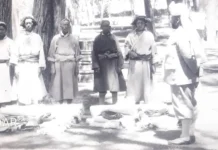
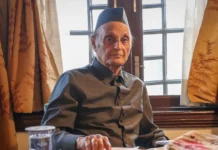
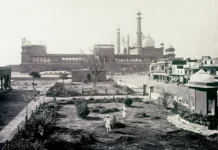
Emperor Shah Jehan’s daughter, Jahanara Begum, held a deep affection for Kashmir. However, unlike other Mughal royalty, her connection to the region was driven by a spiritual quest guided by Mulla Shah Badakhshi. Muhammad Nadeem writes that this unique relationship not only shaped her life but also bestowed Kashmir with some of its finest monuments.
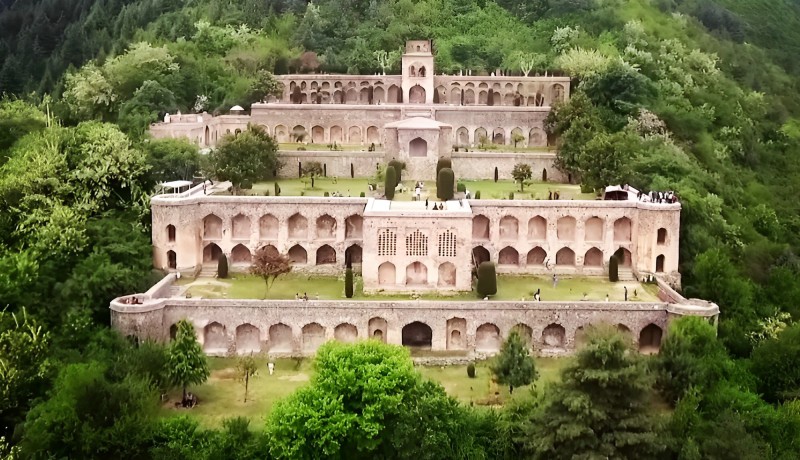
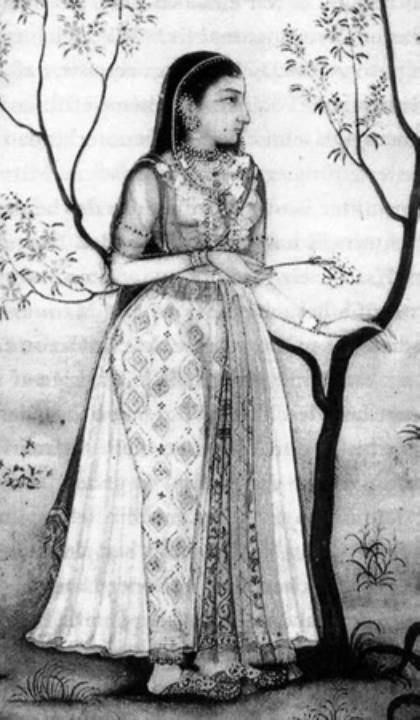
Jahanara Begum (1614–1681), the eldest daughter of Mughal Emperor Shah Jahan, was a prominent figure in the Mughal Empire, known for her influence in political and spiritual spheres. Her life and travels, particularly to Kashmir, were marked by her engagement with Sufism, her patronage of architecture, and her role in managing the imperial household.
Her era was characterised by significant cultural and economic developments, and Jahanara’s travels played a vital role in promoting these aspects. In Kashmir, the Mughal Empire is remembered for its architectural achievements, including the creation of gardens and the use of running water in palaces and leisure resorts. Influenced by these cultural elements, the Mughal princess made efforts to enhance the aesthetic and spiritual dimensions of the places.
Jahanara embraced Sufism as a means of personal and spiritual expression, reflecting a connection between the imperial family and the spiritual lineage rooted in their Timurid heritage.
Journey to Kashmir
Princess Jahanara undertook significant journeys to Kashmir. The Mughal dynasty’s relationship with Kashmir was marked by imperial fascination with its natural beauty and strategic importance. For Jahanara, however, the journey held deeper significance. It was an opportunity to strengthen her spiritual ties and seek mentorship from the eminent Sufi, Mulla Shah Badakhshi, a disciple of Miyan Mir.

Her visit took place during the reign of her father, Shah Jahan, who had already solidified Mughal rule over Kashmir. The Mughal control of the region was not only a political assertion but also a cultural one. The emperors introduced Persianate architecture, gardens, and literature, embedding Mughal aesthetics into Kashmir’s cultural fabric. Jahanara’s journey, however, had a dual purpose—imperial oversight and spiritual fulfilment.
In 1640, Jahanara’s journey to Kashmir commenced as she accompanied her father’s royal entourage. Her account of the journey, as documented in her writings, emphasises the grandeur and sublimity of Kashmir. Describing Kashmir as heaven’s partner, she noted its unparalleled beauty. The Mughal royal household’s journey was a logistical spectacle, with elephants, camels, soldiers, and attendants forming a grand procession.
Upon reaching Kashmir on March 31, 1640, Jahanara’s focus shifted from the physical to the spiritual. She sought the company of Mulla Shah, the Sufi master known for his ascetic life and spiritual wisdom. Her efforts to establish a connection with Mulla Shah reveal her humility and devotion. Initially, Mulla Shah maintained detachment, reluctant to engage with the royal household. However, Jahanara’s persistence, underscored by acts of humility such as preparing food with her own hands, eventually earned his favour.
Spiritual Encounters
The central aspect of Jahanara’s stay in Kashmir was her spiritual engagement with Mulla Shah. Her narrative reveals the profound impact this encounter had on her spiritual journey. Guided by Mulla Shah, she experienced moments of divine revelation and mystical awakening. Her reflections echo the central tenets of Sufism, emphasising devotion, self-effacement, and the pursuit of divine truth.
One of the most notable moments in her journey occurred when she meditated on the practice, known as tasawwur (visualisation), common in Sufi mystical traditions. Through this exercise, Jahanara claimed she experienced visions of the Prophet and his Companions, strengthening her resolve to pursue the Qadiri path. Her dreams and visions affirmed her spiritual station, marking a shift from the worldly concerns of courtly life to a more profound spiritual quest.
Jahanara’s life illustrates the depth of her devotion to Mulla Shah. She described his luminous presence, his austere lifestyle, and his divine knowledge. Her recognition of him as a perfect master reflects the Sufi ideal of the spiritual guide who leads the disciple (murid) to divine truth. Her encounters with Mulla Shah transformed her understanding of Sufism, shifting her allegiance from the Chishti to the Qadiri order, a significant spiritual and ideological move within the Mughal court.
Impact on the Region
Jahanara’s sojourn in Kashmir left a lasting imprint on the region’s cultural, architectural, and spiritual landscape. Her patronage extended to the construction of the Mulla Shah Mosque now ruins in Srinagar, a site that remained significant in Kashmir’s religious topography. This mosque, like other Mughal structures in Kashmir, embodied Persianate architectural aesthetics, symbolising the synthesis of imperial power and spiritual devotion.
Her presence in Kashmir also heightened the region’s stature as a spiritual hub within the Mughal empire. By aligning herself with the Qadiri order, she brought greater recognition to Kashmir’s Sufi networks. Her patronage of Mulla Shah, a pivotal figure in Kashmir’s Sufi milieu, reinforced Kashmir’s spiritual importance, making it a site of pilgrimage for future generations of Sufis and mystics.
Political and Cultural Significance
Jahanara’s journey to Kashmir was not only a spiritual endeavour but also a subtle assertion of political influence. Her role as Padshah Begum (Lady of the Age) granted her considerable power in the court. Her choice to align with Mulla Shah and the Qadiri Sufi order had political connotations, especially in the context of the Mughal succession struggle. Her brother Dara Shikoh, the heir apparent and a close confidant, was also a disciple of Mulla Shah. Her support for Dara’s claim to the throne was further legitimised by their shared spiritual ties.
Jahanara’s position as a political actor becomes evident when viewed alongside the broader Mughal patronage of Sufi orders. The Mughal emperors’ support for Sufi saints and shrines was a means of legitimising their rule, as Sufi networks had deep-rooted influence among the populace. Jahanara’s devotion to Mulla Shah, therefore, was not only a personal spiritual journey but also a strategic alignment with a powerful spiritual network that could bolster her family’s claim to authority.
Departure and Reflections
As Jahanara prepared to leave Kashmir, her writings conveyed a sense of sorrow and spiritual yearning. Her final meeting with Mulla Shah was marked by profound emotion. She recorded how Mulla Shah gifted her a sash (dupatta) from his shoulders, a symbolic gesture denoting spiritual succession and divine blessing. Her reflections on this moment are filled with gratitude, humility, and a sense of divine favour.
Her departure from Kashmir marked the end of an extraordinary spiritual journey. The gifts she received from Mulla Shah—both material and spiritual—solidified her transformation. Her reflections upon leaving Kashmir underscore the depth of her devotion and her realisation of the impermanence of worldly power. She departed with tearful eyes but with a heart imbued with divine grace and inner light.
Influence on Mughal Politics
Princess Jahanara Begum played a pivotal role in the political landscape of the Mughal Empire. As the daughter of Emperor Shah Jahan, she wielded considerable influence in royal decision-making, often acting as an intermediary between her father and the nobles at court. Jahanara’s position allowed her to champion various political and cultural initiatives, contributing to the governance and stability of the empire. Her engagement in state affairs was not merely symbolic; she was known to have shaped critical policies and served as a trusted advisor, showcasing the potential of women to impact governance during the sixteenth and seventeenth centuries
Jahanara’s legacy is deeply intertwined with the patronage of arts, literature, and music during the Mughal era. Her support of various artistic endeavours fostered a vibrant cultural milieu, leading to the creation of exquisite works that enriched India’s cultural heritage. She was instrumental in the establishment of gardens and architectural projects, such as the famous Shah Jahan’s mausoleum, the Taj Mahal. Moreover, her contributions to literature and poetry have been recognised as significant, marking her as a notable figure among the intellectual elite of her time.
Challenging Gender Norms
The legacy of Princess Jahanara, alongside other influential women like Nur Jahan and Chand Bibi, challenges the prevailing gender norms of their era. These women defied societal expectations, asserting their agency and influence in a patriarchal society. By becoming leaders, administrators, and patrons of the arts, they broke stereotypes and set precedents for future generations of women.
Their stories serve as powerful inspirations, highlighting the importance of recognizing women’s contributions to societal and cultural advancements. Jahanara’s life reflects a unique blend of privilege and agency, illustrating how women navigated and shaped their roles within the confines of their societal structures.
Reflections on the Present
In contemporary discourse, Kashmir is often viewed through the lens of conflict and instability, diverging sharply from the idyllic experiences of travellers like Jahanara. The historical context of her travels reflects a time when the region was seen as a beacon of hope amidst communal strife in the Mughal Empire. As Kashmir’s narrative has transformed into one of violence and division, the memories of peace and beauty have receded into the background, making it challenging to reconcile Jahanara’s experiences with the present-day realities of the region.