A sudden government ban on trekking routes across Jammu and Kashmir has upended the region’s thriving adventure tourism sector, leaving local operators, guides, and allied workers staring at massive financial losses, mass cancellations, and an uncertain future, Babra Wani reports
Every trekking point in the region, many of which are nestled deep within forested areas across Jammu and Kashmir districts, stands shut. These offbeat trails, cherished by both residents and non-native trekkers over the past three years, have experienced a steady increase in foot traffic. Now, they stand deserted, and the community that depended on them is in turmoil.
“This ban has severely impacted adventure stakeholders in Kashmir,” said Zeeshan Mushtaq, a young trekker and climber. “Everyone, logistics providers, trek organisers, pony handlers, porters, guides, have seen their work plummet.”
For decades, venturing deep into mountains to map glaciers and explore remote wilderness has been a niche yet vital part of Kashmir’s broader tourism economy. Historically, the region has produced legendary hunting guides and trekking managers known for their expertise.
Game Reserve
For most of its history, even before the Mughals annexed Kashmir, the valley has been famed for its hunting. It became very popular after 1946 following the British selling Kashmir to Gulab Singh. Britons made Kashmir a popular destination. Dozens of books were published to guide hunters, hikers and trekkers into Kashmir’s rugged but fascinating mountainside.
In the summer of 1925, Theodore Roosevelt Jr and his younger brother Kermit Roosevelt, sons of the former US President Theodore Roosevelt, arrived in Kashmir on a hunting-scientific expedition. The purpose was to collect specimens, especially the elusive Ovis Poli, for the Field Museum of Natural History in Chicago. Their journey brought them to Srinagar, where they were received by famed Bandipore shikaris Rahim and Khalil Lone, who became indispensable companions on the months-long Himalayan adventure.
Their Kashmiri leg was critical. The Roosevelt brothers camped in Ganderbal, then crossed the treacherous Zojila Pass en route to Leh with their caravan of 60 ponies, scientific equipment, and an experienced local team. Guided by the Lone brothers, engaged earlier through renowned explorer Douglas Burden, the Americans traversed the upper Sindh Valley and Karakoram before entering Central Asia. The brothers’ deep trust in the Kashmiri guides is a recurring theme in their book East of the Sun and West of the Moon, which chronicles this expedition.
Rahim Lone, in particular, is lauded for his leadership and unmatched knowledge of high-altitude game. The Roosevelt expedition marked a high point in Kashmir’s lesser-known role in early 20th-century exploration, and the Lone brothers became part of international hunting lore. In the pages of their travelogue, amid stories of ibex, bears, and the fabled Marco Polo sheep, Kashmir and its legendary hunters were immortalised in American natural history.
The process continued till recently. There were game reserves across Kashmir for duck, bird and animal hunting. During winters, Hokersar would remain busy with hunters. Of late, the policy shifted. The hunting was banned, and the trekking was encouraged. Steadily but surely, this led to the emergence of a huge adventure tourism sub-sector that witnessed high and low in the last 40 years. After a few years of massive demand, trekking has started nose-diving again.
Serious Concerns
People affiliated with this thrilling, adventurous sector are hugely concerned. “The season was about to start, preparations were underway, but now everything is lost,” Zeeshan said, referring to the situation that arose after the April 22 Pahalgam massacre. Most of the tourist sites across Kashmir are restricted. “Even if the government lifts the ban, fear persists. That fear will stop tourists from coming.”
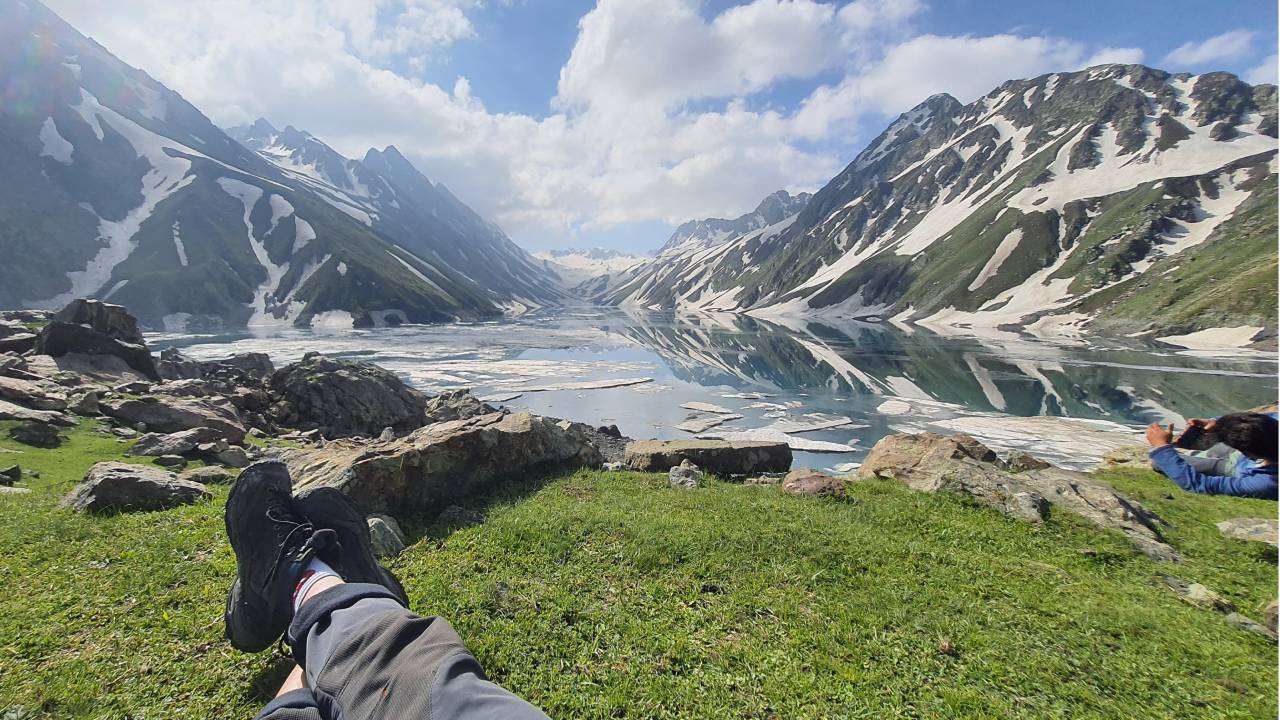
Over the years, adventure sports such as trekking, climbing, and hiking have become integral to tourism in Jammu and Kashmir. However, the sudden restriction has left many stakeholders anxious and uncertain. “People have invested heavily, money, time, and effort, in building this culture. Some left their jobs to pursue this full-time. Now, most are upset, confused, and angry,” he added.
Another trekker voiced the shared sentiment: “There is just one question on everyone’s mind: what have we done to deserve this?” Insiders in the trekking fraternity insist the atmosphere has grown tense, and livelihoods are at stake.
A Sudden Surge
Trekking saw a significant surge after the government announced 100 new tourist destinations in 2024 to boost exploration and adventure. In recent years, routes were mapped and developed across six circles, Srinagar, South, North, East, West, and Chenab, with each circle offering over 10 trails. The North Circle, covering Baramulla and Kupwara near the Line of Control, led with 26 routes. The Srinagar and South circles each had over 20, while in the Jammu division, 24 trekking paths were identified across Jammu, Kathua, Poonch, Rajouri, Udhampur, Kishtwar, and Doda.
Zeeshan noted that even if trekking were reinstated, caution would prevail. “Most of us are reluctant to take responsibility, not just for others but even for ourselves,” he said.
He urged authorities to lift the ban and simplify the permit process. “We should be allowed to lead groups with prior permission from the Tourism Department, as we did earlier. People have made serious investments in this sector.”
“This was the season,” he said. “It is already over.”
Even the security grid has issues. Reports about the migrant herdsmen from the Pir Panchal range are not getting permission to move up the meadows with their flocks. After the media reported the issue for many days, certain permissions were granted in Budgam. The herdsmen have traditionally spent half of the year in the high-altitude meadows with their flocks and would go home by late autumn.
Decline in Bookings
Ali Ahmer Baigh, who runs an outdoor company specialising in treks and hikes, said it was too early to assess the full impact of the recent restrictions. “Our hikes and short treks planned for May have already been cancelled due to the ongoing ban. All those involved, pony riders, guides, and cooks, are already suffering,” he said.
He hoped the authorities would revoke the ban soon so activities could resume and livelihoods could be restored. Hiking and trekking have become popular in the last few years to the extent that groups would land at Srinagar airport and directly leave for trekking, bypassing the urban visits to Srinagar.
Danish Dharm, who founded Hike The Trails Adventures Pvt Ltd in 2020, said the season was effectively over. “This is not a one-year problem. Its impact will stretch into the coming years. It feels like it is over for us.”
He estimated the losses could exceed Rs 50 lakh. “Tourist footfall was very high this year, and we had expected profits to cross Rs 50 lakh. With all our bookings cancelled, the losses will be equally significant.”
The psychological toll was just as severe. “The fear is real. Earlier, we could plan and move freely. Now, the risk is not in the mountains but in the circumstances,” he said. Many clients, he added, cancelled their expeditions and demanded refunds. “We returned the money to some, while others are on hold. Several messaged us saying Kashmir is unsafe and asked to cancel bookings.”
Idle Investments
Danish had invested over Rs 15 lakh in setting up the company but now expressed little hope. “There is zero activity, no groups, no treks. All offbeat locations are shut. We hope the Great Lakes trek may resume due to the army deployment in the area. But for other trails and spots, it looks impossible.”
He said the uncertainty had discouraged newcomers. “Especially beginners are no longer considering coming here.”
The company had partnered with non-native firms and expected around 25 groups of 15 members each, totalling 300 to 500 people, including foreigners. “Some made bookings; others were expected to sign up locally. But everything has come to a halt.”
Several non-local companies had also announced cancellations online. “It is now up to the authorities to manage the situation,” he said.
Industry-Wide Fallout
Aarif, who owns the adventure company Cliffhangers, echoed Danish’s concerns. “This ban has had several negative consequences. The first is on employment, many people in the sector will be left jobless.”
He warned the measure would send a negative message about Kashmir and that it could push youth towards drug abuse. “Trekking has become a mainstream sport here, like cricket. It’s loss will isolate the young generation.”
While Aarif acknowledged that some areas might require restrictions for security reasons, he said a blanket ban was not justified.
The closure of trekking routes across Jammu and Kashmir has impacted key adventure tourism circuits in Baramulla, Kupwara, Kathua, Rajouri, Poonch, Udhampur, Kishtwar, and the Chenab Valley. Among the most popular now off-limits are the Kashmir Great Lakes Trek, the twin lakes of the Tarsar Marsar Trek, Tulian Lake near Pahalgam, the Nafran Valley Trek, Warwan Valley, and the Pir Panjal Lakes.
Local guides and tourism stakeholders warned that the restrictions would lead to severe economic and experiential losses.
Devastation in Pahalgam
A trekking guide from Pahalgam said the livelihood of his team, ten guides, had been decimated. “Unemployment will rise. People are left to fend for themselves. In this part of Kashmir, there is total dependency on tourism. With these bans, everything is over for us.”
“We have nothing but hope. We will sit back and think. Many of us will be forced into manual labour. Most of us are burdened with debt. Not just us, but other stakeholders too, cab owners bought vehicles on loans. With tourism shut down, we have no way to repay. To be honest, we are doomed.”

Manage Solid Waste
Sections within the adventure sports sector are talking in hushed tones about the solid waste that is dumped on the treks. There is a desperate need to clean these foot treks of the huge plastic waste that has been thrown around. Over the years, the trekkers have been reassembling the waste for proper disposal but still lot of it is scattered around.
“It is a concern,” Faiz Bakhshi, a Kashmir Chamber executive, who is also an ecological activist, said. “The crisis is that the government has closed these treks and tourist spots and is not allowing anybody, which is a major handicap.” He said the security personnel have been posted on all accesses towards these spots to the extent that even going to the Shankaracharya temple is slightly problematic. “My mother is buried in a graveyard on the rear of Dalgate and I had to make a serious effort to reach her grave for prayers because the graveyard is part of the trek that goes up the Shakarachrya hill,” he said.